
Last Updated on 11/11/2026 by Daniel G. Taylor
Estimated reading time: 12 minutes
Connection shapes the way your mind works.
Ask anyone who has spent a long winter alone. Days blur, sleep slips, and small worries swell until they fill the house. How does social interaction affect mental health? Company steadies your mood, eases stress and gives each week its shape. Take it away, and the damage builds in silence.
The world has noticed. The World Health Organization’s Commission on Social Connection found one in six people worldwide feel lonely, and in 2025 it linked loneliness to more than 871,000 deaths each year.
This guide explains what the research shows, why connection grows harder when you live with a mental health condition, and how SALT helps people across Greater Melbourne and the Mornington Peninsula find their people again.
I live with bipolar I disorder, but I’m not an NDIS participant, and don’t describe my condition as a psychosocial disability. I do know the challenges of isolation and the benefits of connection. When people encounter me during a manic episode, it’s a lot to handle. They often withdraw from me and I don’t have the headspace to rebuild or maintain those relationships. The most important social relationships in my life are my family and my church. In the over two years I was homeless, I learned people you’re connected to in your circle make a huge difference in your own behaviour. The lesson is to choose a peer group who bring out the best in you.
Key Takeaways
- Social interaction plays a crucial role in mental health, improving mood, reducing stress, and supporting recovery.
- Loneliness and isolation significantly raise the risk of psychological distress and mental health issues.
- Condition-specific support, like that from SALT, can facilitate re-engagement with social activities and relationships.
- Quality of connections matters more than quantity; meaningful relationships enhance mental wellbeing.
- Technology can complement social interactions but should lead you back to human connections for greater support.
Table of contents
- What Social Connection Does for Your Brain and Body
- How Does Lack of Social Interaction Affect Mental Health?
- Withdrawal From Social Interaction: How the Cycle Starts
- Quality Over Quantity: What Healthy Connection Looks Like
- Can Apps, Chatbots, Wearables and Online Communities Help?
- NDIS Support for Social Connection
- Where to Find Connection in Melbourne and the Mornington Peninsula
- Action Steps
- Frequently Asked Questions
- Conclusion: Connection Is a Skill You Can Rebuild
- Related Reading
What Social Connection Does for Your Brain and Body
Your nervous system reads trusted company as safety. Time with people who know you calms the body’s stress response, and a calmer body thinks more clearly, sleeps more deeply and heals faster.
Nick Tebbey, National Executive Officer of Relationships Australia, sees the payoff in resilience. “When people engage in social interaction, they feel more resilient because they know they have a support network,” he says.
Regular social engagement shapes mood and behaviour too. Research shared by the Australian Psychological Society found loneliness raised a person’s likelihood of depression by 15.2% and social anxiety by 13.1%. Lonely Australians also reported poorer psychological health, a lower quality of life and fewer meaningful relationships.
The effect runs both ways, and the loop gives connection its power. Good company lifts your mood, and a lifted mood makes company easier to seek. Each conversation becomes a small deposit in an account you draw on when life turns hard.
Does social interaction help mental health when you live with a long-term condition? The evidence says yes. Connection won’t replace treatment, but it gives treatment something to build on.
How Does Lack of Social Interaction Affect Mental Health?
Isolation works slowly. One cancelled catch-up becomes a fortnight indoors, a fortnight becomes a season, and a season becomes the way life is. A lack of social interaction affects mental health long before you notice the change.
Dr Mark Timlin, a mental health GP with headspace, puts connection at the centre. “70% of mental health issues are related to a lack of connection and acceptance,” he said. The harm also turns inward. “Lack of social interaction can breed negative self-belief around feeling alienated, isolated, socially alone,” Dr Timlin says.
The Australian Institute of Health and Welfare (AIHW) estimates 15% of Australians aged 15 and over experienced loneliness in 2024, and 15% experienced social isolation. The AIHW links both to psychological distress and poor mental health.
Loneliness and isolation differ, however. Isolation counts the people you see. Loneliness measures how disconnected you feel. You can sit in a crowded room and still feel alone, so the quality of your contact matters more than its quantity.
People with severe and enduring mental illness carry the heaviest load. A University of Western Australia study of the Australian National Survey of Psychosis found loneliness ranged from about 75% in delusional disorder to 94% in depressive psychosis. Around 35% of the wider community felt the same.
People with psychosis are too often pushed to the edges by stigma, symptoms and medication side effects. Our guide on how to support someone with schizophrenia shows families and support workers how calm routines protect connection.
Withdrawal From Social Interaction: How the Cycle Starts
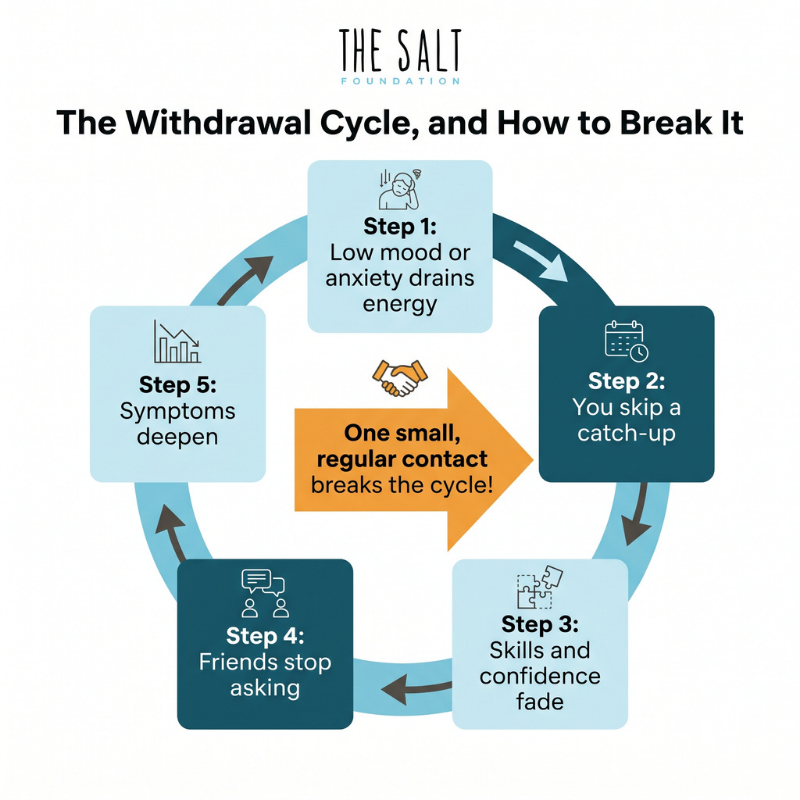
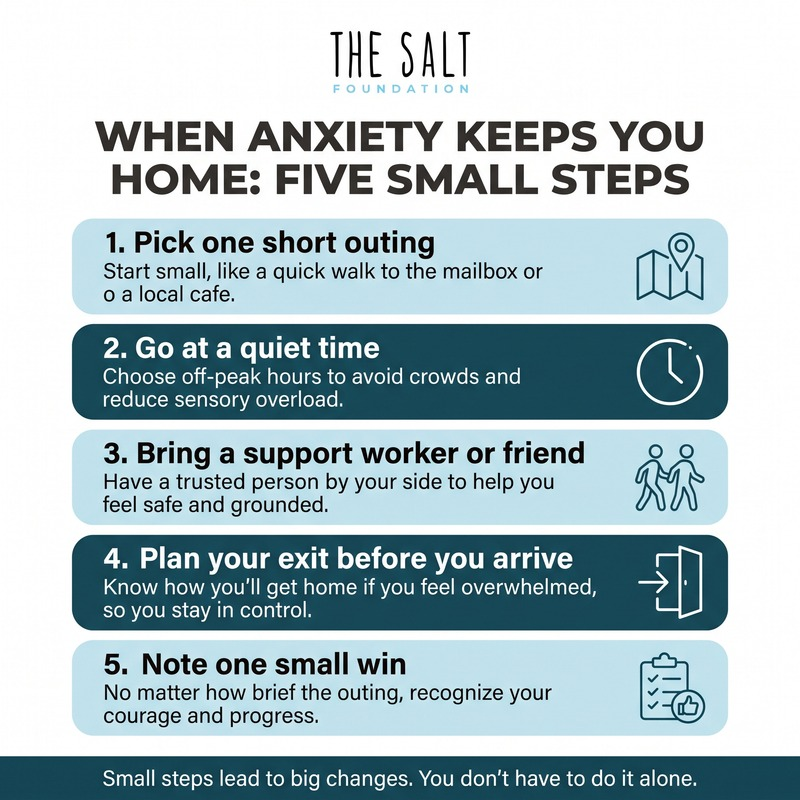
Withdrawal rarely feels like a choice. Low mood drains your energy. Anxiety turns a café into a stage. Voices or paranoia turn strangers into threats. You stay home because home feels safer, until the walls close in.
Each skipped outing makes the next one harder. Skills fade, confidence shrinks and friends stop asking. Withdrawal from social interaction then feeds the symptoms behind it, and the cycle tightens.
Willpower alone seldom breaks the cycle. Small, repeatable steps do. A support worker who knocks on your door each Tuesday achieves what a hundred good intentions cannot.
“For someone who has spent years mostly at home, the first step back is usually a small one,” says Harriet Dixon, psychosocial recovery coach at The SALT Foundation. “A coffee at the same café, at a quiet time, with someone they trust.”
“Rest and withdrawal can look alike, so I watch the direction,” Dixon said. “Rest leaves someone feeling restored. Withdrawal shrinks their world a little more each week.”
Small wins compound. “One woman I work with started with a takeaway coffee on Tuesdays,” Dixon says. “Months later, she stays for a second cup and chats with the regulars.”
Quality Over Quantity: What Healthy Connection Looks Like
You don’t need a packed calendar. One reliable friend, one regular group and a few warm conversations a week protect your mental health better than a phone full of contacts.
Dr Timlin starts with give and take. “A healthy connection is about meeting needs and being reciprocal,” he says. Healthy connections, in his words, are “reciprocal, respectful and interdependent.” He also names the opposite. “Unhealthy connection could be where the connection is coercive or controlling,” Dr Timlin said.
Tebbey urges realism. “Not every relationship is always smooth sailing. If we’re realistic with our expectations, we’re less likely to be hurt,” he said.
The right amount of connection belongs to you. “Relationships are entirely subjective to each person,” Tebbey says. He suggests two questions to ask yourself: “Do I need one person or a whole group around me? Do you have the energy to put yourself into one relationship or many?” Your answers set the measure, not someone else’s social media feed.
Knowing your needs also protects you. “If you don’t think about what you need, you put your own needs as secondary to someone else,” Tebbey said.
Can Apps, Chatbots, Wearables and Online Communities Help?
Technology can open a door, but it works best when it leads you back to people.
Mental health apps help you track mood, practise breathing and rehearse new skills. Treat them as a bridge to your GP, clinician or recovery coach, not a replacement.
Online communities ease isolation when the front door feels too heavy to open. SANE Australia runs free peer support forums for people affected by complex mental health issues and their carers, and mental health professionals moderate them around the clock. The best online groups help you feel understood, then nudge you back toward the world outside.
AI chatbots draw growing concern. Beyond Blue told the Productivity Commission it holds significant concerns about AI-generated mental health advice, which can be inaccurate and, at worst, unsafe. A chatbot can help you plan what to say before a hard conversation. It cannot sit beside you while you say it.
Wearable devices can’t measure connection, but they reveal patterns: how often you leave the house, how far you walk, how well you sleep. Share those patterns with your support team, because they often show withdrawal before you feel it.
NDIS Support for Social Connection
The NDIS treats connection as part of a good life. Two support categories, plus recovery coaching, can fund your way back into community, and the NDIS guide to social and community participation explains what each covers.
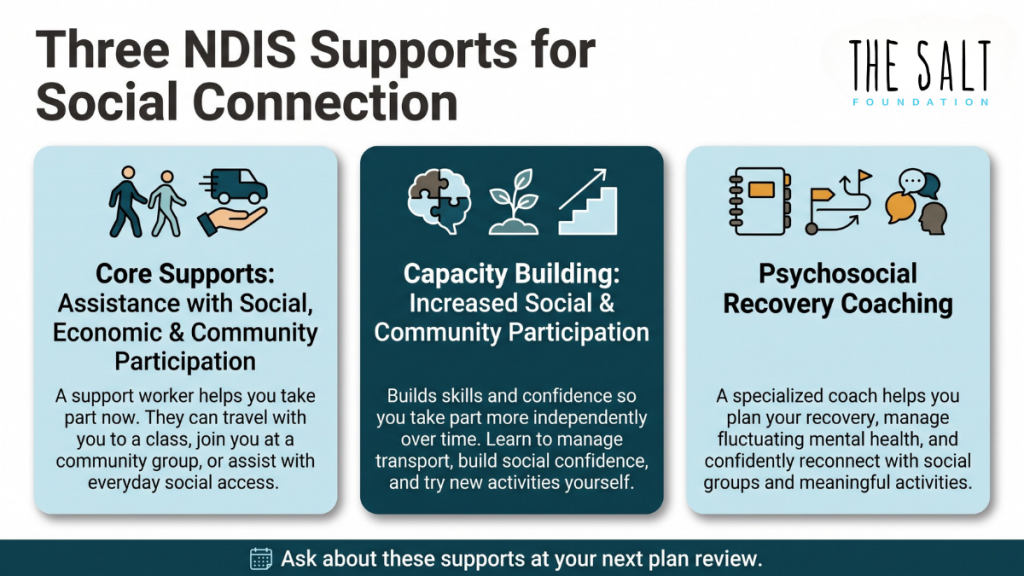
- Core Supports (Assistance with Social, Economic and Community Participation) fund help to take part now. A SALT support worker might travel with you to a class or sit beside you at a community lunch.
- Capacity Building Supports (Increased Social and Community Participation) fund skill-building, so you take part more independently over time. Our capacity building services include group programs and life-skills workshops.
- Psychosocial Recovery Coaching helps participants with a psychosocial disability plan their recovery and reconnect with groups, activities and people.
Fit matters too. The NDIA’s social inclusion research asked participants what helped them get out into the world, and it named support workers matched in age, skills and interests as a key enabler.
“The right match makes those first outings easier,” says Greg Smith, chief operating officer at The SALT Foundation. SALT’s Care Team weighs each participant’s needs and preferences against available support workers, from age and gender to interests and specialised training.
“Where there’s a strong match, we encourage a meet and greet so the participant can test the relationship first,” Smith said.
Our guide on how to get NDIS funding walks newcomers through the first steps.
Where to Find Connection in Melbourne and the Mornington Peninsula
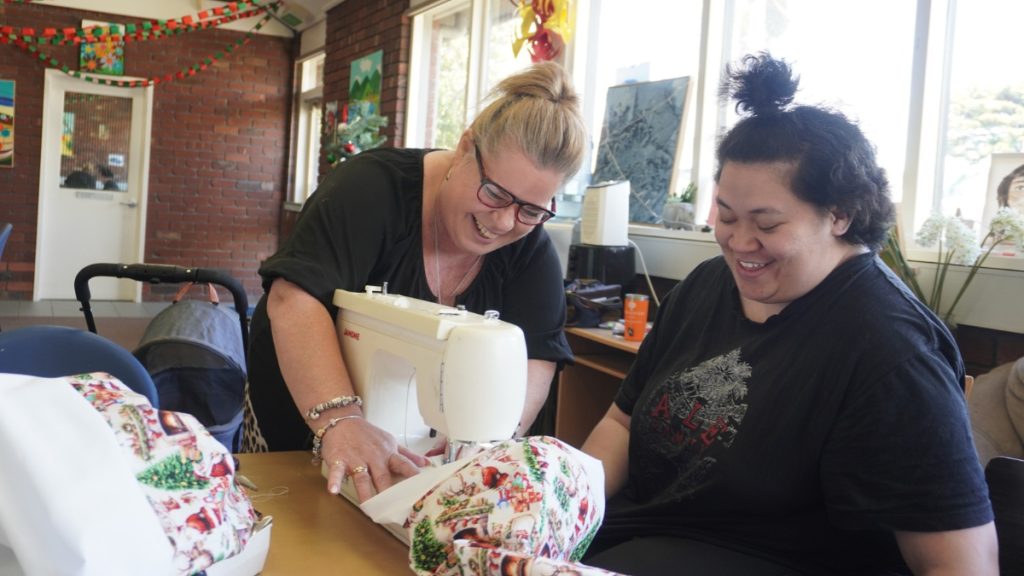
Shared activity makes connection easier than conversation alone. Talk flows without pressure while your hands stay busy.
SALT day programs. Our day programs at The Well in Heidelberg West and Asha House in Frankston offer cooking, arts and crafts, sewing and eco therapy, plus IT workshops and outings to tenpin bowling, museums and galleries. Small groups and sensory-friendly spaces let you settle in at your own pace.
“It helps people’s mental health and wellbeing to be around other people,” said Roger Donnelley, CEO of The SALT Foundation.
Tebbey’s advice for anyone ready to widen their circle starts close to home. “If someone does want to reach out and make better relationships, look at where those relationships exist,” he says. He points to “joining clubs, reaching out to different interest groups.”
Neighbourhood Houses. Victoria has more than 400 Neighbourhood Houses. Most run low-cost classes, community lunches, gardens and support groups, and many welcome people of all abilities.
Mental Health and Wellbeing Locals. These free Victorian services support adults aged 26 and over, and they need no GP referral, mental health care plan or Medicare card.
Social anxiety support. The Anxiety Recovery Centre Victoria supports people with anxiety disorders on 1300 269 438, and its team understands how anxiety affects social interaction in daily life.
Action Steps
- Name your starting point. Write down who you spoke with this week and how each contact felt. Honest notes show you where to begin.
- Schedule one small, regular contact. Same day, same time, every week. Rhythm beats intensity.
- Choose an activity, not just a chat. Cooking, gardening or crafts let connection grow side by side.
- Use technology as a bridge. Let apps and forums lead you toward people, never away from them.
- Add connection to your NDIS goals. Ask about community participation supports and psychosocial recovery coaching at your next plan review. Our guide to NDIS goal setting shows you how to frame them.
- Ask for a support worker who fits. Shared interests, age or background help a new relationship settle.
- Reach out today. Call SALT on 1300 777 258 or enquire online, and we’ll help you take the first step.
Frequently Asked Questions
Yes. Regular, warm contact steadies mood, lowers stress and guards against depression and anxiety. It works alongside treatment, not in place of it, and quality outweighs quantity.
Anxiety makes ordinary contact feel risky, so you avoid it. Avoidance brings short-term relief, yet it shrinks your world and feeds the fear. Lonely Australians report more social anxiety, so each problem fuels the other. Gradual, supported exposure with a clinician, coach or trusted support worker reverses the pattern, one step at a time.
Group-based programs show promise. An ANU-led trial of Groups 4 Health found participants’ loneliness, social anxiety and depression symptoms fell significantly. Your GP can also prepare a mental health treatment plan, your nearest Mental Health and Wellbeing Local offers free support, and NDIS participants can explore recovery coaching.
A chatbot can help you rehearse a conversation or name your feelings. Beyond Blue warns, however, AI advice can be inaccurate or unsafe, so never lean on a chatbot in a crisis. Treat it as practice for human connection, not a substitute.
Start with the Anxiety Recovery Centre Victoria, SANE Australia’s peer support forums and your local Neighbourhood House. NDIS participants can also join SALT’s small-group day programs in Heidelberg West and Frankston.
Yes, when social connection appears in your plan goals. Capacity Building funding under Increased Social and Community Participation can cover skill-building programs, and Core funding can pay a support worker to join you. Make a referral to SALT to get started.
Keep the door open without pushing. Invite rather than insist, suggest low-pressure activities and show up consistently. Contact their treating team if withdrawal deepens or warning signs appear. Call Lifeline on 13 11 14 in a crisis, or 000 in an emergency.
Conclusion: Connection Is a Skill You Can Rebuild
How does social interaction affect mental health? It shapes your mood, your stress and your recovery, and its absence steals all three without a word. Connection isn’t a fixed trait, though. It grows back like any skill, through practice, patience and the right support.
You don’t have to rebuild it alone. SALT’s support workers, recovery coaches and day programs across Greater Melbourne and the Mornington Peninsula help NDIS participants take one small step, then the next, then the one they never thought they’d take. Get NDIS support from SALT or call 1300 777 258 today.
Related Reading
- What Is Psychosocial Disability?
- How to Support Someone with Schizophrenia: A Practical Guide for Families, Carers and Support Workers
- Achieving NDIS Capacity Building Goals: My Journey and Yours
- NDIS Goal Setting: Building a Life Beyond the Plan
- How to Get NDIS Funding

Daniel G. Taylor has been writing about the NDIS for six years. His focus has been on mental health and psychosocial disabilities as he lives with bipolar I disorder. He’s been a freelance writer for 32 years and lives across the road from a surf beach. He’s the author of How to Master Bipolar Disorder for Life and a contributor to Mastering Bipolar Disorder (Allen & Unwin) and he’s a mental health speaker. In May 2026, he celebrated 25 years without a major manic or depressive episode.