

Last Updated on 05/11/2026 by Daniel G. Taylor
A diagnosis opens the file. Function decides the funding.
Mental Health Month closes this week. Mental Health Australia chose Together We Thrive as its 2026 theme, a reminder that connection protects us. World Mental Health Day carried its own theme this year, built around lived experiences heard. Both point to the same fact for anyone who applies to the NDIS: your story, told in plain and specific detail, carries more weight than your diagnosis.
So this guide gives you examples of psychosocial disability drawn from the six areas of life the NDIS assesses. It also draws on something new: what our own client records show about the people SALT supports across Melbourne and the Mornington Peninsula.
This post closes SALT’s Mental Health Month: Together We Thrive series. Read it with our guides to how professionals diagnose mental health conditions, how to support someone with schizophrenia and what the NDIS covers for mental health.
What Is Psychosocial Disability?
Psychosocial disability describes what happens when a mental health condition meets daily life, and daily life loses. Our cornerstone guide, What Is Psychosocial Disability?, covers the definition in depth. Here, the short version will do.
A mental illness is a health condition. A psychosocial disability, on the other hand, is the long-term impairment in functioning that illness can cause. For example, one person with schizophrenia works full time, while another cannot open the mail. Same diagnosis. Different disability.
Similarly, the NDIS draws the same line. It assesses impact across six areas of daily life, set out in Section 24 of the NDIS Act: communication, social interaction, learning, self-care, self-management and mobility. Our guide to impairment in functioning explains how planners read each one.
Who Lives With Psychosocial Disability? What SALT’s Own Data Shows
National figures tell one story. However, our client records tell another.
In September 2026, we reviewed the records of the 202 people SALT actively supports. More than half, 115 people or 57%, have a psychosocial or mental health condition recorded (SALT Foundation client records, September 2026). Across Australia, by comparison, psychosocial disability is the primary disability for about 9% of participants, according to the NDIS Quarterly Report appendices for 31 March 2026.
Schizophrenia and Older Age Stand Out
The detail matters more than the headline. Sixty-one people we support live with schizophrenia, schizoaffective disorder or paranoid psychosis, which makes up 30% of everyone we work with. Their median age is 53. Across the whole group, 42% of the people we support are 55 or older, compared with 15% of NDIS participants nationally, according to the same report.
In other words, these numbers describe real neighbours. Most of the people we support live in Melbourne’s north, around Banyule, Darebin and Whittlesea, or in Frankston and on the Mornington Peninsula. Many have lived with a severe and enduring mental illness for decades, and most want one thing above all: to keep living well in their own homes.
Greg Smith, SALT’s Chief Operating Officer, calls that share “far above the national figure”. “That reflects who SALT has always served, and it is where our team’s experience runs deepest,” he said.
How We Counted
One note on method. Our figures count every condition recorded against a person, while the NDIS counts one primary disability per participant. So read the comparison as a guide, not a like-for-like measure.
Which Mental Health Conditions Can Lead to Psychosocial Disability?
No diagnosis qualifies on its own. The NDIS bases its decisions on the impact of a mental health condition, not on the name of the condition. Even so, some conditions appear again and again. Among the people SALT supports, the most common recorded conditions include:
- schizophrenia and schizoaffective disorder
- anxiety disorders
- depression
- post-traumatic stress disorder, including complex PTSD
- bipolar disorder
- obsessive-compulsive disorder
- borderline personality disorder.
Families of people with psychosis often ask where to start, and our schizophrenia guide, earlier in this series, answers that question. Anxiety also raises its own eligibility questions, which we cover in Is Anxiety a Disability?
Many people also carry more than one condition. In our records, 52 of the 195 people with any disability recorded, about one in four, carry conditions from more than one category (SALT Foundation client records, September 2026). Co-occurring conditions rarely add together neatly. Instead, they multiply.
Examples of Psychosocial Disability Across the Six NDIS Domains
Each example below describes a barrier, not a symptom. That difference matters because it shapes how a planner reads your evidence. “I have depression” names a condition; “I go a fortnight without showering when my depression is severe” names a barrier the NDIS can fund support for.
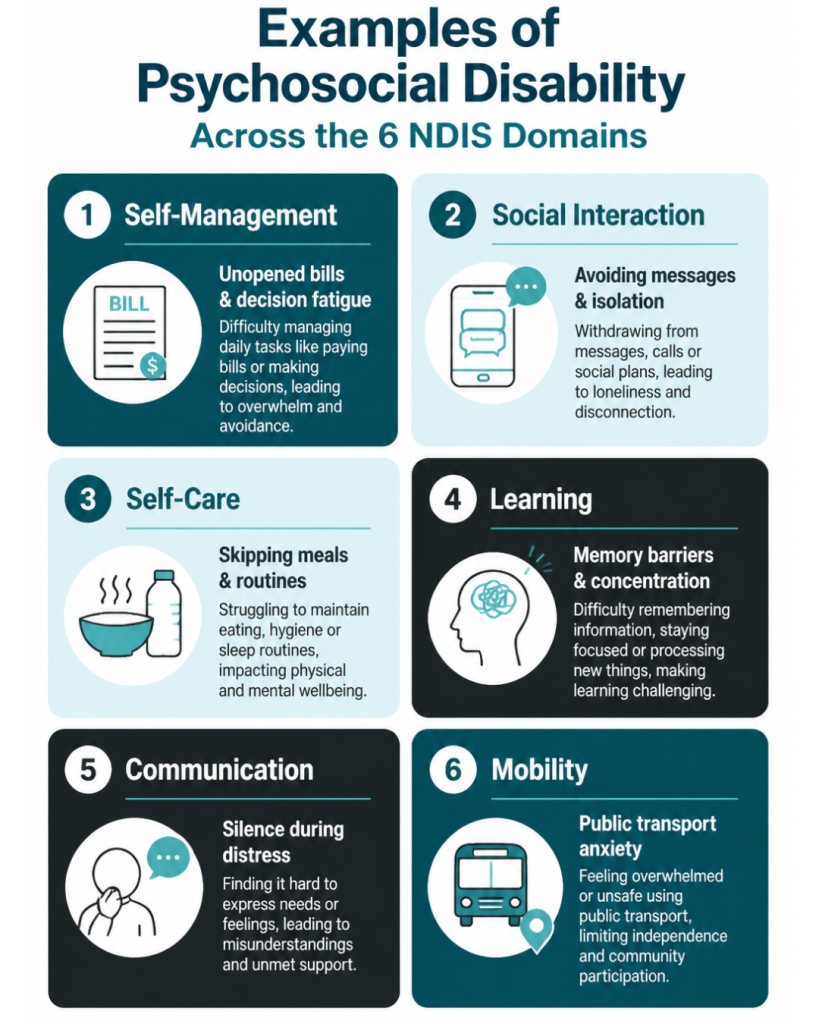
1. Self-Management
Self-management covers planning, decisions, money and problem-solving. It asks whether you can run your own life without someone stepping in.
A man with schizophrenia believes his bank is watching him. He stops opening statements, then bills, then the letters from his energy retailer. As a result, the power is cut before anyone notices.
A woman with severe depression knows she needs to eat, shower and take her medication. She cannot decide which to do first, so she does none of them. Ultimately, the decision itself becomes the barrier.
A person with bipolar disorder misses doses for days during a depressive episode, despite understanding why the medication matters. In fact, understanding was never the problem. Capacity was.
Lived Experience: Closing the Gap Between Knowing and Doing
I live with bipolar I disorder, even though I’m not an NDIS participant. While I’ve been stable since 2001, I have to have things like having a shave and shower and cleaning my teeth on a checklist to make sure I do them.
I protect sleep most – bipolar is, after all, a circadian rhythm disorder – and while I practise good sleep hygiene, some nights my sleep doesn’t go to plan. I had poor sleep on Saturday night and I’m writing this on Tuesday afternoon after another night of low-quality sleep.
To close the gap between knowing and doing, I find it helpful to have a Master Checklist split into three categories: Must Get Done, Should Get Done, Could Get Done. When I’m struggling to manage my condition, working from a checklist as Atul Gawande teaches in The Checklist Manifesto removes the decision-making load.
2. Social Interaction
Social interaction covers relationships, friendships and community life. For many people with psychosocial disability, connection feels less like comfort and more like risk.
A woman with social anxiety leaves her friends’ messages unanswered for weeks, convinced she said something wrong the last time they met. Over time, the friendships fade, not from lack of love but from the fear of reaching out.
A man in his sixties has lived with schizophrenia since his twenties. Over four decades, the illness thinned his circle to his elderly mother and his GP. So when his mother moves into aged care, he loses his only daily conversation.
Above all, isolation compounds every other barrier. Together We Thrive speaks directly to the people we support, which is why SALT hosts a free community dinner where no one has to perform.
3. Self-Care
Self-care covers personal hygiene, dressing, eating and looking after your health. During acute episodes, however, it can stop altogether.
A person with major depressive disorder goes weeks without showering or brushing their teeth. They know how. However, the act itself feels impossible.
A man with psychotic symptoms believes his food has been poisoned. As a result, he loses dangerous amounts of weight beside a fully stocked fridge.
A woman with schizoaffective disorder skips her GP check-ups for two years. Her blood sugar climbs, unnoticed, while everyone watches her mental health.
4. Learning
Learning covers how you take in, remember and use new information or skills. Mental illness, and the medication that treats it, can slow all three.
A man on antipsychotic medication cannot remember instructions his support worker gave him five minutes earlier. He feels embarrassed, so he stops asking questions.
A woman with anxiety and ADHD reads the same paragraph of a TAFE module ten times and retains nothing. That’s because her concentration fractures every few seconds.
An older participant cannot learn to use the myGov app after his local Centrelink office reduces its counter hours. Consequently, every new system becomes a new wall.
5. Communication
Communication covers how you express your needs and understand others. Yet psychosocial disability often breaks communication down at the exact moment a person needs it most.
A woman with post-traumatic stress disorder goes silent during a flashback. When she speaks again, the fragments fail to convey how frightened she was.
A man with schizophrenia speaks less and less as negative symptoms deepen. Meanwhile, his psychiatrist sees him for fifteen minutes and hears “I’m fine”.
A person in a manic episode cannot follow a multi-step instruction because their thoughts outrun it.
6. Mobility
Mobility covers moving around your home and your community. Unlike physical disability, psychosocial disability usually puts the barrier in the mind, not the legs.
A man with agoraphobia cannot travel more than a few streets from home. Even the walk to the pharmacy triggers a panic attack, so prescriptions lapse.
A woman with paranoia cannot sit on a crowded train because she believes other passengers are talking about her. Consequently, she misses her psychiatrist appointments rather than face the journey.
Why Transport Matters
Transport matters more than most people realise. Indeed, more than half the people SALT supports, 111 of 202, have transport built into their support arrangements (SALT Foundation client records, September 2026).
Three Impacts of Psychosocial Disability on Daily Routines
Ask people what psychosocial disability changes, and the same three answers return.
The Routine Breaks
Sleep drifts. Meals vanish. Appointments slip. A predictable day protects mental health, yet the illness attacks predictability first, so one bad week can undo months of steady habits.
The World Shrinks
Friends drift, shops feel too far away, and home becomes the only safe room. Eventually, a life that once spanned a suburb can contract to a single street.
The Paperwork Piles Up
Letters, forms, renewals and portals keep arriving, whether or not you can read them. For many people with psychosocial disability, therefore, unopened mail becomes the first visible sign of trouble.
Catherine, a SALT support worker, knows that pile well. One man she supports hadn’t opened his mail in months. “The letters sat in a pile on the kitchen table, and every new one made the pile harder to face,” she says.
So they started small. Each week, they open five letters together over a cup of tea and sort them into three piles: pay, file and ask for help. Now he opens most of them himself and saves the hard ones for her.
“What families and planners often miss is how much effort that takes,” Catherine said. For her, progress looks like “a little less of me and a little more of him, week by week”.
How Psychosocial Disability Changes as People Age
Severe mental illness rarely retires. For many of the people we support, age brings new pressures on top of old ones.
First, physical health conditions arrive, and they need managing alongside mental health. Then parents who cared for an adult child for thirty years grow frail themselves. Meanwhile, the supports a person relied on in their forties no longer fit in their sixties.
Many of the people SALT supports with schizophrenia are in their fifties and sixties. They need, Greg says, “a provider who notices when their physical health starts to change, plans ahead for the day ageing parents can no longer help, and keeps the same familiar faces around them”.
His advice for families unsure where to begin is simple. “Tell us what a hard week looks like, and we’ll start there,” Greg said.
Age also affects eligibility. You must apply to the NDIS before you turn 65, although participants who join before 65 can keep their NDIS support afterwards. Check the NDIS eligibility requirements early if you or a family member is approaching that age.
Many conditions also move in waves rather than a straight line. Our guide to the episodic nature of psychosocial disability explains how to document the bad stretches, not just the good ones.
Why Your Examples Matter More Under the 2026 NDIS Laws
The rules changed this year. Parliament passed the Securing the NDIS for Future Generations legislation on 19 August 2026, and some changes have already started.
What Changes From October 2026
From 1 October 2026, support budgets for social, economic and community participation, and for improved daily living skills, reduce when a plan is reassessed or a new plan is approved. Then, from 1 February 2027, the same reductions apply when a plan is renewed. These budgets carry real weight for people with psychosocial disability, who commit 30% of their plan budgets to social and community participation, the highest share of any disability group, according to Mental Illness Fellowship of Australia’s submission to the Senate inquiry.
After that, access changes follow. From January 2028, new applicants face eligibility decisions based on a new standardised assessment of functional capacity, and existing participants will be reassessed over three years.
What This Means for Your Evidence
In short, every one of these changes turns on function. So specific, dated, written examples of psychosocial disability now protect your plan as much as they support your application. You can still ask for a plan reassessment when your functional capacity or circumstances change significantly.
For Harriet Dixon, a Psychosocial Recovery Coach at SALT, a strong example is specific. “‘I struggle with shopping’ tells a planner very little,” she says. “‘Last Tuesday I left the supermarket without buying anything because the crowd set off my paranoia, and I didn’t eat properly for two days’ tells them exactly what the support is for.”
With budgets reducing at reassessment, Harriet urges participants to start writing these examples down now, especially anything about getting out into the community or managing daily tasks. “Good weeks make it hard to remember the bad ones,” she said. So the people she coaches keep a simple notebook or phone note going all year, and they write in it on the hard days, not months later.
Where to Find Psychosocial Support in Melbourne and the Peninsula
Support comes from more than one door. The right door depends on your needs, your age and whether you have an NDIS plan.
NDIS Support From SALT
SALT works from The Well in Heidelberg West, serving Greater Melbourne, and from Asha House in Frankston, serving Frankston and the Mornington Peninsula. Our Psychosocial Recovery Coaching builds daily skills and routines, while our Core Supports team helps with shopping, cleaning, appointments and community access.
Support Outside the NDIS
- Free government-funded mental health services: Mental Health and Wellbeing Locals offer free support to Victorian adults aged 26 and over, with no GP referral needed. Medicare Mental Health on 1800 595 212 can also point you to local services.
- Support groups and peer connection: SANE runs free online forums for people living with complex mental health issues and for their families. Social anxiety groups often meet through Mental Health and Wellbeing Locals too.
- Workplace adjustments: JobAccess, the Australian Government’s disability employment service, explains workplace adjustments and the funding employers can access for them.
Seeing the Person First
Roger Donnelley, SALT’s Chief Executive Officer, says seeing the person first has been at the heart of SALT from the start. For someone who has lived with schizophrenia for thirty years, it means “asking what they enjoy, what they are proud of and what they want next, before we ever ask about symptoms”.
Roger also has a message for people who have held back. “If you live in Banyule or Frankston and have never asked for help, reaching out is not a sign of failure,” he said. “You don’t need the right words or a full set of paperwork.”
Our teams at The Well and Asha House are close by. “Call us, or ask someone you trust to call for you, and we’ll take it from there,” Roger says.
Action Steps
- Write down three recent examples. First, choose three moments from the past month when your condition stopped you doing something in one of the six domains. Then note what happened, how long it lasted and what help you needed.
- Describe barriers, not symptoms. For instance, swap “I have anxiety” for “I cannot catch the train to my appointments because of panic attacks”.
- Record the bad weeks. Keep a simple diary through an episode, so your evidence reflects your hardest days, not just the day of your assessment.
- Ask your treating team for functional evidence. Specifically, request reports from your GP, psychiatrist or psychologist that describe what you can and cannot do, not only your diagnosis. Our guide to how to get NDIS funding walks through the evidence the NDIS expects.
- Check your age and your plan dates. In particular, if you are approaching 65, or your plan is due for reassessment, act now.
- Talk to SALT. Enquire with SALT about recovery coaching and daily support, or ask a health professional to make a referral.
Frequently Asked Questions
Is psychosocial disability a diagnosis?
No. A psychiatrist diagnoses a mental health condition, such as schizophrenia or bipolar disorder. Psychosocial disability, by contrast, describes the long-term impact that condition has on your daily life. Therefore, the NDIS funds support for the impact, not the diagnosis.
What is the difference between a mental disability and a psychosocial disability?
People often use “mental disability” loosely to mean either a mental illness or an intellectual disability. Psychosocial disability, however, means something narrower: functional impairment caused by a mental health condition. Our guide to psychosocial disabilities and NDIS eligibility explains the distinction in full.
What are common examples of psychosocial disability the NDIS recognises?
Common examples include being unable to manage money or bills, leave home, use public transport, keep up personal hygiene, maintain relationships or communicate needs during an episode. The NDIS looks for these impacts across its six functional domains, and many people experience barriers in several domains at once.
How can I identify signs of psychosocial disability?
Look for patterns that last, not single bad days. Typical warning signs, for example, include unopened mail, missed appointments, withdrawal from friends, neglected hygiene and difficulty leaving home. If you notice these signs in yourself or a family member, talk to a GP first.
Can I have support coordination and psychosocial recovery coaching at the same time?
Yes. Support coordination helps you understand your plan and connect with providers. In contrast, recovery coaching builds your capacity to manage daily life. The two roles complement each other, and many plans fund both.
What if I’m already over 65?
You cannot make a new NDIS application after you turn 65. However, support through My Aged Care and state mental health services remains available, and Mental Health and Wellbeing Locals welcome adults of any age from 26.
Conclusion: Your Examples, Your Voice
Examples of psychosocial disability are not paperwork. Instead, they are lived experience, written down so a system built on forms can hear it. This Mental Health Month, as Australia talks about thriving together, the most useful thing you can bring to the NDIS is your own story, told plainly, in the language of daily life.
Related Reading
- What Is Psychosocial Disability?
- How to Support Someone with Schizophrenia
- Does the NDIS Cover Mental Health?
- Managing the Episodic Nature of Psychosocial Disability
- What Is Disability?
- How to Get NDIS Funding

Daniel G. Taylor has been writing about the NDIS for six years. His focus has been on mental health and psychosocial disabilities as he lives with bipolar I disorder. He’s been a freelance writer for 32 years and lives across the road from a surf beach. He’s the author of How to Master Bipolar Disorder for Life and a contributor to Mastering Bipolar Disorder (Allen & Unwin) and he’s a mental health speaker. In May 2026, he celebrated 25 years without a major manic or depressive episode.