
Last Updated on 03/07/2026 by Daniel G. Taylor
Estimated reading time: 7 minutes
Choice and control. The NDIS built its entire framework on those three words.
Yet many participants in Melbourne and across the Mornington Peninsula arrive at their first plan review feeling anything but in control — confused by the language, unsure of their rights, and uncertain whether their support is actually working. This guide addresses that gap directly. Working with the NDIS effectively means leading your team, not just receiving their help; and the difference between those two postures determines everything.
Key Takeaways
- Choice and control form the core of the NDIS framework, empowering participants to actively manage their support.
- Effective communication with your support worker is crucial; clarify your goals and progress regularly.
- Use a communication diary to document interactions and reflect on your progress toward goals.
- Participants have the right to change providers if their needs aren’t being met; communicate openly with your coordinator.
- The SALT Foundation offers resources like hubs to assist NDIS participants in achieving their goals.
Table of Contents
- Working with the NDIS: What ‘Choice and Control’ Actually Means
- Managing Your NDIS Plan: How to Communicate Your Goals
- How to Match Your Personality to Your Support Worker
- Using the Heidelberg West and Frankston Hubs as Resources
- What to Do When the Relationship Isn’t Working
- Frequently Asked Questions
- Action Steps: Start This Week
- Conclusion: Your Plan, Your Leadership
- Related Reading
Working with the NDIS: What ‘Choice and Control’ Actually Means
The NDIS does not manage your life. It funds your goals.
Consequently, the participant who understands what disability actually means under the NDIS — and what the scheme was built to fund — holds far more power than the one who treats their plan as a passive entitlement.
Choice and control means you select your providers, shape your schedule, and redirect support when it stops serving you. However, exercising that power requires two things most participants are never explicitly taught: self-advocacy and clear communication.
Before you lead your team, ensure you understand exactly what is a support worker NDIS and how they fit into your plan.
Managing Your NDIS Plan: How to Communicate Your Goals
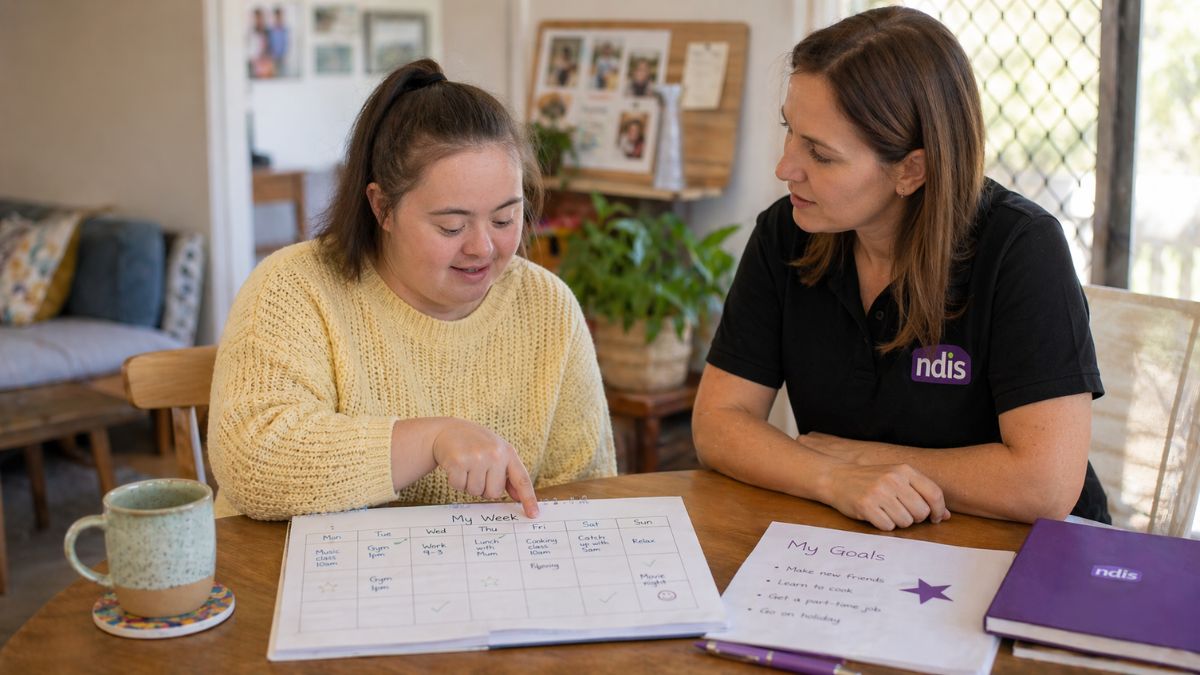
Every productive support relationship begins with a conversation your worker can’t have without you: what does success look like for you, specifically?
Your support worker cannot read your plan and extract your ambitions from it. You must name them.
Specifically, try this at your next session. Tell your worker three things: what you want to achieve this month, what has worked before, and what has not. That single exchange reframes the dynamic from service delivery to genuine partnership.
Use a Communication Diary
A communication diary needs no special software. One ruled notebook works.
After each session, write one sentence: what happened, and whether it moved you toward your goal. Review the diary with your coordinator monthly.
Over time, that record becomes evidence — evidence you can use to strengthen your plan at review, switch providers if needed, or demonstrate your progress to the NDIA.
Schedule Monthly Goal Reviews
Managing your NDIS plan means treating it as a living document, not a filed form.
Monthly reviews with your coordinator keep your goals calibrated to your actual life — which changes, sometimes quickly. Set a recurring date in your calendar and protect it.
How to Match Your Personality to Your Support Worker

Skills matter. Character, however, determines whether the relationship actually works.
A support worker with every qualification on paper but a communication style that clashes with yours will frustrate rather than empower you. Conversely, a worker who genuinely understands your rhythm, your pace, and your humour can transform an ordinary session into genuine progress.
When you meet a new worker, ask yourself two questions: Do I feel heard? Do I feel respected? If the answer to either is no after three sessions, raise it with your coordinator.
Success begins with the right team; read our NDIS support worker pillar page to find your match in Melbourne.
Using the Heidelberg West and Frankston Hubs as Resources
The SALT Foundation operates two activity centres built specifically for NDIS participants: The Well in Heidelberg West and Asha House in Frankston.
Both hubs run structured programs designed to build skills, foster friendships, and give participants a platform for community participation. Moreover, both centres provide something harder to quantify: a place where your goals are taken seriously by people who have seen what participants can achieve when properly supported.
Your support worker can accompany you to either centre. Alternatively, your coordinator can incorporate hub participation directly into your support schedule.
Working with the NDIS in Melbourne and the Mornington Peninsula means using every resource available to you. The hubs exist for exactly that purpose.
What to Do When the Relationship Isn’t Working
Providers are not permanent fixtures. You hold the right to change them.
If a support worker or provider consistently fails to meet your needs — arriving late, ignoring your stated goals, or communicating poorly — that pattern matters. Document it in your communication diary, raise it with your coordinator, and if the problem persists, request a change.
The NDIS funds your goals, not a provider’s convenience. That distinction, kept firmly in mind, gives you the authority to act.
Frequently Asked Questions
Monthly contact is a reasonable baseline. However, the right frequency depends on your plan complexity, your current goals, and whether anything in your support is changing. If your plan includes a support coordinator as a funded line item, use them fully. They exist to help you navigate the NDIS, resolve provider issues, and prepare for plan reviews — not simply to check in once a quarter.
Raise it early. A direct conversation with your coordinator or provider is always the first step; many issues resolve quickly when named. If the relationship remains unproductive, you retain the right to change providers. Your funding follows your goals, not any specific organisation. The SALT Foundation’s teams in Heidelberg West and Frankston can walk you through that process if you need support making the transition.
Your communication diary is the simplest tool. Beyond that, ask your support worker to note progress against your specific NDIS goals after each session. Many coordinators also use goal-tracking templates you can complete monthly. Whatever format you choose, the discipline of recording progress turns vague aspiration into documented evidence — which carries real weight at plan review.
You can request an unscheduled plan review if your circumstances change materially — a new diagnosis, a significant change in support needs, or a major life event. Contact the NDIA directly or ask your support coordinator to initiate the review on your behalf. Come prepared: bring your communication diary, a summary of your current supports, and a clear statement of what needs to change and why.
You hold the right to choose your own providers, set your own goals, access information about your plan, and make complaints without fear of losing your support. The NDIS Quality and Safeguards Commission handles complaints about provider conduct. Furthermore, your local area coordinator can help you understand your rights in plain language before any review or provider conversation.
Action Steps: Start This Week
Working with the NDIS rewards participants who act, not those who wait. Here are five steps you can take immediately.
- Start your communication diary. Buy a notebook or open a notes app. After your next session, write one sentence about what happened and whether it moved you toward your goal.
- Name your top three goals. Write them down in plain language — not NDIS jargon. Share them with your support worker at your next session and ask how they plan to work toward each one.
- Schedule a monthly review. Book a recurring date with your coordinator now. Treat it as non-negotiable; your plan review depends on the evidence you build between now and then.
- Visit a hub. Contact The SALT Foundation to arrange a visit to The Well in Heidelberg West or Asha House in Frankston. See what programs run there and whether any align with your current goals.
- Know your right to change. If a provider or support worker isn’t working for you, write it down, raise it with your coordinator, and act on the answer. Your plan funds your goals — full stop.
Conclusion: Your Plan, Your Leadership
Working with the NDIS rewards participants who understand one truth: the plan serves you, not the other way around.
Self-advocacy, clear communication, and the courage to change what isn’t working — these are not optional extras. They are the foundation of a support relationship that actually delivers.
The SALT Foundation supports NDIS participants across Melbourne and the Mornington Peninsula, at The Well in Heidelberg West and Asha House in Frankston, with care grounded in Christian compassion and a genuine commitment to your goals.Ready to lead your support team? Enquire with The SALT Foundation today and let’s build a plan that works as hard as you do.
Related Reading
- What Is Disability? Unpacking the Definition in the NDIS Era
- NDIS Goal Setting: Building a Life Beyond the Plan
- NDIS Support Workers: How to Find Your Perfect Match
- NDIS Plan Management: Simplifying Your Support
- How to Get NDIS Funding

Daniel G. Taylor has been writing about the NDIS for six years. His focus has been on mental health and psychosocial disabilities as he lives with bipolar disorder I. He’s been a freelance writer for 32 years and lives across the road from a surf beach. He’s the author of How to Master Bipolar Disorder for Life and a contributor to Mastering Bipolar Disorder (Allen & Unwin) and he’s a mental health speaker. In May 2026, he celebrated 25 years without a major manic or depressive episode.