
Last Updated on 05/11/2026 by Daniel G. Taylor
Estimated reading time: 12 minutes
Nobody knows the exact number.
Australia measures its rainfall to the millimetre and its house prices to the dollar, yet our best estimate of the prevalence of schizophrenia in Australia still leans on a survey from 2010. In 2023, SANE Australia warned the country has no data on who lives with schizophrenia or where they live.
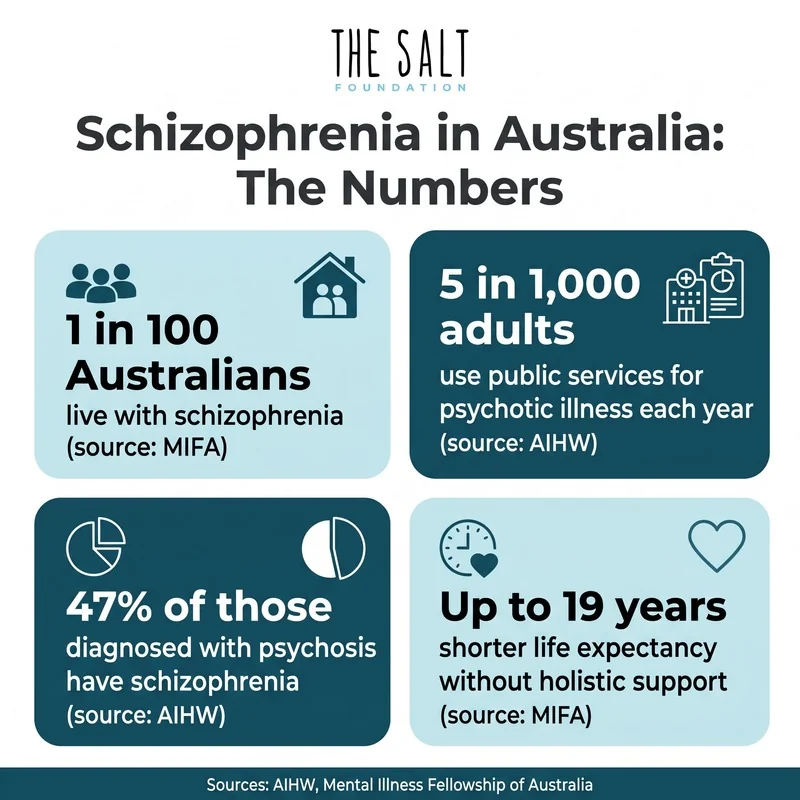
The figures we do have still tell a clear story. Schizophrenia affects about 1 in 100 Australians across a lifetime. It usually arrives in the late teens or early twenties. Then it stays, often for decades, long after youth services have handed people on.
That last point matters most to us. At The SALT Foundation, we support people through the long middle chapter of schizophrenia, at home and in their communities across Greater Melbourne and the Mornington Peninsula. This guide brings together the latest Australian statistics, what they leave out and the support you can reach today.
Key Takeaways
- The prevalence of schizophrenia in Australia is about 1 in 100, with treated cases at 5 in 1,000 adults.
- Australia lacks recent data, with the last significant survey conducted in 2010, leaving many individuals uncounted.
- The SALT Foundation supports individuals living with schizophrenia, emphasizing that it doesn’t end at 25 years old.
- Australians can access various support services, including the NDIS, Orygen, and SANE for ongoing care.
- Many misconceptions exist about schizophrenia, particularly regarding its impact on life expectancy and capabilities.
Table of Contents
- How Common Is Schizophrenia in Australia?
- Schizophrenia Does Not End at 25
- How Common Is Schizophrenia Among Young Adults in Victoria?
- What Are the Main Risk Factors for Schizophrenia?
- How Do Australian Clinicians Diagnose Schizophrenia?
- Where to Find Schizophrenia Support in Melbourne
- How the NDIS Supports People Living With Schizophrenia
- Myths Hiding Behind the Statistics
- Action Steps
- Frequently Asked Questions (FAQs)
- Conclusion: Behind Every Statistic Sits a Life Worth Supporting
- Related Reading
How Common Is Schizophrenia in Australia?
Three measures frame the prevalence of schizophrenia in Australia. Each one counts something different, so read them side by side.
Lifetime risk: about 1 in 100
One person in every hundred lives with schizophrenia, according to the Mental Illness Fellowship of Australia. Neuroscience Research Australia’s Professor Shannon Weickert gives the same lifetime figure, noting in a NSW Health release most people first experience the condition in their late teens and early twenties.
International research lands close by. The latest Australian and New Zealand schizophrenia treatment guidelines estimate lifetime prevalence at around 0.7% worldwide, with variation by region and study design.
Treated prevalence: 5 in every 1,000 adults
The Australian Institute of Health and Welfare (AIHW) still draws on the 2010 Survey of High Impact Psychosis. It estimated 64,000 Australians aged 18 to 64 lived with a psychotic illness and were in contact with public specialised mental health services each year. That equals 5 cases per 1,000 people. Schizophrenia accounted for almost half (47%) of those diagnoses.
Treated prevalence counts only people already inside the public system. Anyone who sees a private psychiatrist, or no one at all, falls outside it.
Why the real number stays hidden
Australia’s largest recent mental health survey, the National Study of Mental Health and Wellbeing 2020–2022, tracks common conditions such as anxiety and depression. Schizophrenia slipped through the gap, as community broadcaster 2SER reported in 2023. SANE summed up the cost of that blind spot in five words: “What gets measured gets done.”
Schizophrenia Does Not End at 25
Most prevalence figures focus on when schizophrenia starts. Far fewer describe how long it lasts.
Australia’s first national psychosis study found the illness ran continuously, without remission, for an average of 15 years after first symptoms for a high proportion of participants. In the 2010 national survey, two-thirds of participants were rated as impaired in their ability to socialise with other people.
Early intervention rightly targets young people at first episode. Yet adults living with schizophrenia at 45, 55 and beyond still need help to shop, cook, keep appointments and stay connected, and the national conversation rarely includes them.
Families often worry a relative in their fifties has left it too late. “Your relative has not missed the boat,” says Roger Donnelley, CEO of The SALT Foundation. “Schizophrenia doesn’t end at 25, and neither does the chance to live well.”
Older adults, he says, need “support that is steady and patient, with the same familiar faces each week, and help with their physical health as much as their mental health.” His promise to families is simple: “At SALT, we meet people where they are, whatever their age.”
How Common Is Schizophrenia Among Young Adults in Victoria?
No Victorian dataset breaks schizophrenia down by age. National research does show when it begins. Researchers at the University of Queensland note schizophrenia usually first presents in young adults.
Sex shifts the timing. Men tend to develop symptoms in their teens and twenties, while women more often develop them in their twenties and thirties, according to WA’s North Metropolitan Health Service. Onset after 45 is rare.
Early intervention programs for first-episode psychosis
Melbourne wrote the playbook. Orygen’s Early Psychosis Prevention and Intervention Centre (EPPIC) opened in 1992 and became the template for hundreds of early psychosis services worldwide. Today, the Orygen Specialist Program supports young people aged 15 to 25 in Melbourne’s western and north-western suburbs.
Early help changes lives. In a seven-year follow-up of 723 EPPIC clients, 57% of people with schizophrenia or schizophreniform disorder reported some paid employment in the previous two years.
What Are the Main Risk Factors for Schizophrenia?
Researchers have not pinned down a single cause. Instead, several factors raise the odds:
- Family history. The Mental Health Council of Australia found cannabis increases young people’s risk of mental illness, particularly for those with a family history of psychosis.
- Early, long-term cannabis use. Young adults who used cannabis for six or more years were twice as likely to develop a non-affective psychosis, in the University of Queensland study of more than 3,800 21-year-olds.
- Age and sex. Onset clusters in early adulthood and arrives earlier for men.
- Pregnancy and birth. Researchers have suggested stress on the mother during pregnancy may contribute, alongside genetic and environmental factors.
A risk factor is not a diagnosis. Most people with one or more of these factors never develop schizophrenia.
How Do Australian Clinicians Diagnose Schizophrenia?
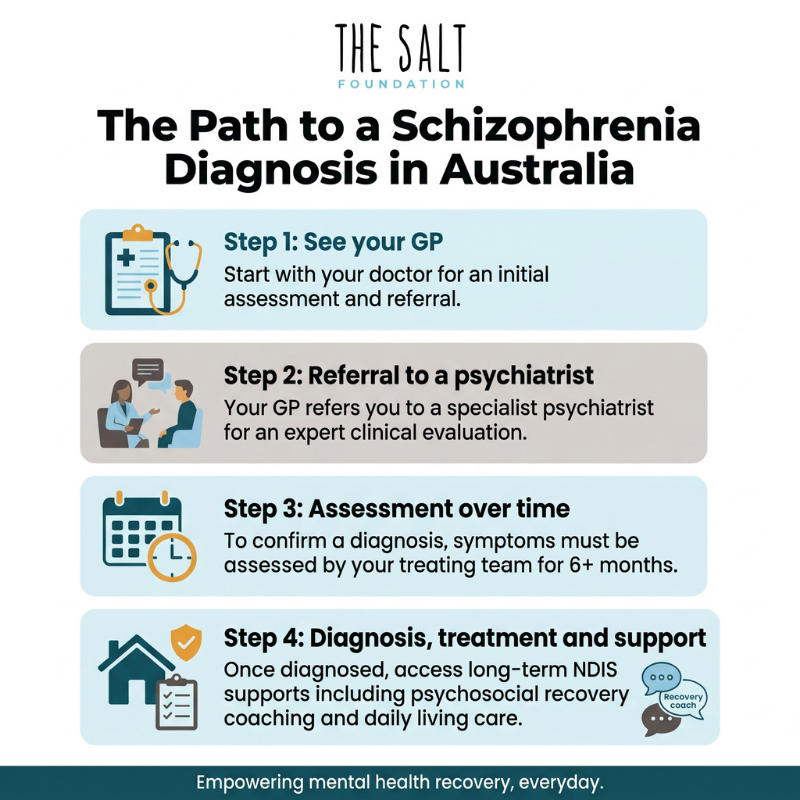
No blood test or brain scan confirms schizophrenia. Diagnosis rests on a comprehensive psychiatric assessment, information from people close to the person and ruling out conditions with similar symptoms, according to the Australian and New Zealand guidelines.
Most people start with a GP. The GP makes an initial assessment and refers on, usually to a psychiatrist, and may order blood tests or scans to rule out other health problems, Embrace Multicultural Mental Health explains.
Time forms part of the test. Symptoms must last at least six months and cause problems at work, study or in relationships before a psychiatrist confirms the diagnosis. For a fuller walk-through, read our guide to how mental health conditions are diagnosed.
Where to Find Schizophrenia Support in Melbourne
Different services suit different stages. Match the service to where you are now:
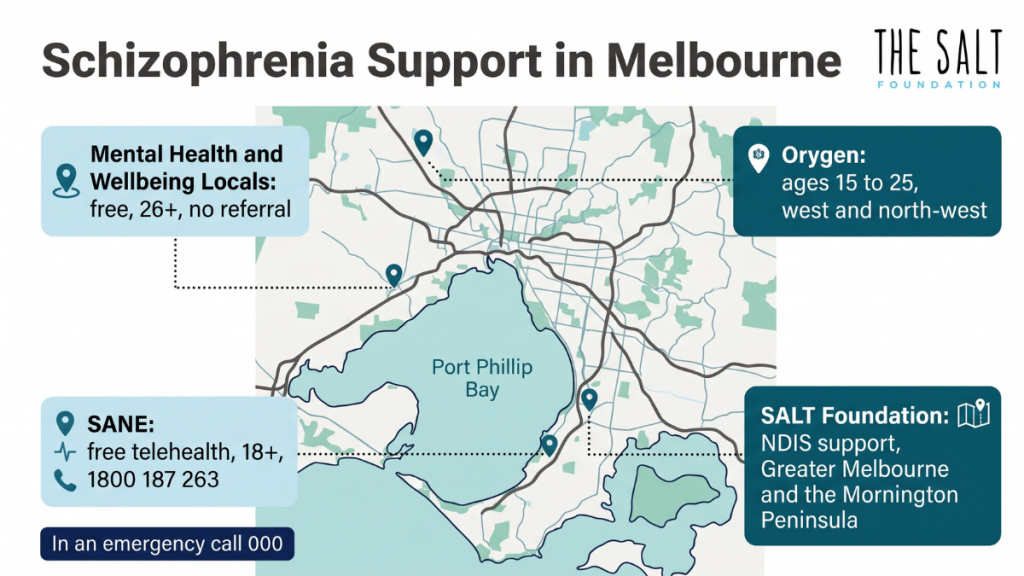
- Mental Health and Wellbeing Locals. Victoria’s free Locals support adults aged 26 and over close to home, with no GP referral or Medicare card needed. Frankston has one. They are not crisis services.
- Orygen Specialist Program. Specialist care for 15 to 25 year olds in Melbourne’s west and north-west, including early psychosis treatment.
- SANE Australia. SANE offers free digital and telehealth support for people over 18 with complex mental health issues, and for their families and carers. Call 1800 187 263.
- The NDIS. Long-term, everyday support for people whose schizophrenia substantially affects daily life. SALT provides NDIS support in Greater Melbourne and the Mornington Peninsula.
In an emergency, call 000. For crisis support, call Lifeline on 13 11 14.
How the NDIS Supports People Living With Schizophrenia
Schizophrenia can lead to psychosocial disability when it substantially and permanently affects daily life. About 65,300 NDIS participants have psychosocial disability as their primary disability, the AIHW reports, making it the scheme’s fourth-largest primary disability group.
A diagnosis alone does not unlock funding. The NDIA looks at how the condition affects everyday functioning, and our cornerstone guide What Is Psychosocial Disability? explains the difference. When you’re ready to apply, How to Get NDIS Funding walks you through access, and our guide to whether mental health counts as a disability in Australia answers the eligibility question.
For people living with schizophrenia, SALT’s support usually combines:
- Support workers who help with shopping, cooking, appointments, transport and staying connected.
- Psychosocial recovery coaching to set goals, build skills and work alongside clinical teams.
- Support coordination to connect your NDIS plan with the right providers.
- Supported Independent Living for people who need help to live well in their own home.
“Recovery after 20 or 30 years doesn’t mean the symptoms disappear,” says Harriet Dixon, a psychosocial recovery coach at The SALT Foundation. “It means building a life you want around them.”
That life starts small. “Often the first goal is something ordinary, like cooking a proper meal or seeing family more often,” Dixon says. Clinical care stays in the loop, too: “With the person’s consent, I keep in touch with their psychiatrist or area mental health team, so we are all working towards the same goals.”
What SALT support looks like week to week
“A typical week might include help with the shopping, a cooked meal at home, a lift to a GP appointment and time out in the community,” said Greg Smith, SALT’s chief operating officer.
The people delivering that support matter as much as the tasks. “We look for support workers who are patient, consistent and calm,” Smith said. “Every worker holds mandatory NDIS Worker Screening Checks and relevant training.”
Getting started takes days, not months. “Once someone signs up with us, support typically starts within a week,” Smith said. Wherever possible, SALT meets new participants in person first to learn their needs, routines, triggers and goals, so the right support is in place from day one.
Myths Hiding Behind the Statistics
Schizophrenia does not mean a split personality. People with schizophrenia show the normal range of intelligence and do not have an intellectual disability. They are also seldom dangerous, especially when they receive treatment and support, according to Embrace Multicultural Mental Health.
The real danger runs the other way. Life expectancy for people with schizophrenia sits up to 19 years below the rest of the population, the Mental Illness Fellowship of Australia warns. Physical illness, including cardiovascular, metabolic and infectious diseases, drives much of the gap, WA’s North Metropolitan Health Service notes. Everyday support with meals, exercise and health appointments counts as more than a convenience. It extends lives.
Action Steps
- See a GP if you notice early signs in yourself or someone you love, such as withdrawal, changed sleep or unusual beliefs.
- Ask about the Orygen Specialist Program if the person is aged 15 to 25 and lives in Melbourne’s west or north-west.
- Walk into your nearest Mental Health and Wellbeing Local if you’re 26 or older and want support without a referral.
- Collect reports from your psychiatrist, GP and other supports describing how schizophrenia affects daily life before you apply to the NDIS.
- Request support workers and psychosocial recovery coaching when you build or review your NDIS plan.
- Contact SALT to talk about support in Greater Melbourne or the Mornington Peninsula. Clinicians and coordinators can make a referral.
- Call 000 in an emergency, or Lifeline on 13 11 14 for crisis support.
Frequently Asked Questions (FAQs)
About 1 in 100 Australians live with schizophrenia, according to the Mental Illness Fellowship of Australia. AIHW data puts the treated prevalence of psychotic illness at 5 per 1,000 adults aged 18 to 64, with schizophrenia accounting for 47% of those diagnoses. No national survey has updated these figures since 2010.
Start with the AIHW’s Mental health pages, which collate national surveys. The NDIS Quarterly Reports track participants with psychosocial disability, and SANE Australia publishes plain-language fact sheets.
SANE Australia supports people with complex mental health issues and their carers nationally. In Victoria, Orygen leads early psychosis care for young people, while Mental Health and Wellbeing Locals support adults. NDIS providers such as SALT deliver ongoing daily support and psychosocial recovery coaching.
Yes. Melbourne’s EPPIC program, run by Orygen, pioneered early psychosis care in 1992 and still serves young people aged 15 to 25 in Melbourne’s west and north-west. Ask a GP about early psychosis services in your area.
Many do. In Orygen’s seven-year EPPIC follow-up, 57% of people with schizophrenia or schizophreniform disorder reported some paid employment in the previous two years. Support workers and recovery coaches can help people build towards work or study goals.
Schizophrenia has no cure, but it responds to treatment. At least 1 in 7 people with schizophrenia fully recover, the Mental Illness Fellowship of Australia says, and some studies suggest the figure may reach 1 in 2.
The NDIS can fund support when schizophrenia causes a psychosocial disability that substantially and permanently affects daily life. Read Does the NDIS Cover Mental Health? for the details.
Conclusion: Behind Every Statistic Sits a Life Worth Supporting
The prevalence of schizophrenia in Australia sits at around 1 in 100, give or take the gaps in our national data. Those gaps hide people: the 20-year-old at first episode, and the 55-year-old who has lived with voices for three decades and still wants a clean kitchen, a decent meal and a friend to share it with.
SALT exists for the second person as much as the first. If you, or someone you support, lives with schizophrenia in Greater Melbourne or the Mornington Peninsula, get NDIS support from SALT today, and support can start within a week. Clinicians and support coordinators can make a referral.
Related Reading
- How to Support Someone with Schizophrenia: A Practical Guide for Families, Carers and Support Workers
- What Is Psychosocial Disability? Moving Beyond the Diagnosis to Claim Your NDIS Support
- Examples of Psychosocial Disability
- Does the NDIS Cover Mental Health?
- How to Get NDIS Funding
- What’s the Worst Mental Illness?

Daniel G. Taylor has been writing about the NDIS for six years. His focus has been on mental health and psychosocial disabilities as he lives with bipolar I disorder. He’s been a freelance writer for 32 years and lives across the road from a surf beach. He’s the author of How to Master Bipolar Disorder for Life and a contributor to Mastering Bipolar Disorder (Allen & Unwin) and he’s a mental health speaker. In May 2026, he celebrated 25 years without a major manic or depressive episode.