
Last Updated on 04/06/2026 by Daniel G. Taylor
Estimated reading time: 6 minutes
Your fitness belongs in your everyday life — not just on one day in March.
SALT’s annual march began as a moment: a celebration, a challenge, a reason to move. Now it has a permanent home at Luna Park, and this space belongs to something bigger. A beginner workout plan, built specifically for people with disabilities across Melbourne and the Mornington Peninsula, sits here now — because the healthiest version of you doesn’t arrive once a year.
You’ve been setting goals. Perhaps you’ve read our guides on NDIS goal setting or capacity building through accountability. A beginner workout plan bridges both: it converts a goal written in a plan into a body that moves through the world more freely.
Key Takeaways
- Your fitness journey is ongoing and starts with small, achievable habits rather than a single event.
- A beginner workout plan helps convert goals into actionable movements, supporting individuals with disabilities in their daily lives.
- Setting low initial milestones, like a ten-minute walk, builds momentum and encourages consistency in fitness.
- Habit tracking simplifies daily movement by automating the commitment to exercise, making it easier to stick to a routine.
- Aligning fitness with personal roles strengthens motivation and clarifies why a beginner workout plan is essential for individual growth.
Table of Contents
Hitting a Low Bar for Initial Milestones
Start smaller than you think you need to.
Momentum builds from tiny wins. Every capacity-building goal you’ve set — every conversation with your support coordinator, every aspiration typed into your NDIS plan — deserves a physical foundation underneath it. A ten-minute walk counts. Gentle chair-based stretching counts. Movement counts, in any form your body can manage today.
Researchers consistently confirm what every good coach already knows: achievable early wins condition the brain to expect success.
Set your first milestone at the lowest possible bar. Clear it. Celebrate it. Then — and only then — raise the bar.
Three Low-Bar Milestones to Start This Week
- Walk for ten minutes around your neighbourhood.
- Complete five minutes of gentle seated movement before breakfast.
- Drink an extra glass of water after any physical activity.
Automating Fitness with Habit Tracking
Willpower depletes. Habits don’t.
A beginner workout plan succeeds when your daily movement stops feeling like a decision. Habit tracking removes the daily negotiation between your intentions and your energy levels. You tick a box. The behaviour sticks.
Simple tools work best. A printed calendar on your fridge, a habit-tracking app on your phone, or a daily check-in with your SALT support worker — each method works, as long as the system stays visible.`
How to Build Your Daily Tracking System
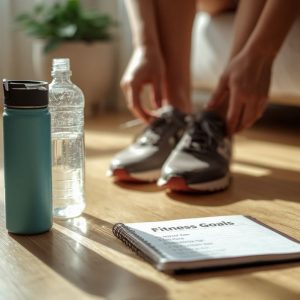
- Choose one movement habit — short, specific, and doable today.
- Track it for seven consecutive days before adding a second habit.
- Review your streak weekly, ideally with your support worker or a trusted person.
Your support worker at The Well in Heidelberg West or Asha House in Frankston can help you build and maintain a tracking routine. Accountability, offered consistently by a skilled professional, transforms a hopeful start into an unshakeable habit.
Aligning Fitness with Your Life Roles
You don’t exercise in the abstract. You exercise as a person with roles that matter.
Stephen R. Covey taught that clarity of role creates clarity of purpose. Ask yourself: who do you want to be? An active parent who kicks a ball in the backyard. An independent adult who catches public transport without anxiety. A student who arrives at class with energy to spare.
Each role tells you why the beginner workout plan matters — and why today’s ten-minute walk isn’t trivial. It’s the physical expression of the person you’re becoming.
Role-Based Goal Examples for NDIS Participants
- Active family member: Build enough stamina to participate in outings without exhaustion.
- Independent community member: Develop the strength and confidence to navigate public spaces across Melbourne.
- Focused learner or worker: Improve concentration and reduce fatigue through regular gentle movement.
- CEO of your wellbeing team: Lead the team of people who support you to create the life that matters to you.
Write down your role. Write down one physical goal it demands of you. Then build your beginner workout plan from there.
Frequently Asked Questions
Support workers provide hands-on care to help you maintain your daily independence. You control your schedule completely by choosing staff who match your unique lifestyle. Find out how to identify your perfect match.
Duties change constantly based on your individual goals and personal requirements — from personal care at home to driving you across the Mornington Peninsula to access the community. See a full breakdown of what support workers do and how to choose the right one for you.
NDIS guidelines generally prohibit paying immediate family members for regular care.
The National Disability Insurance Agency approves funding for external providers to protect your personal relationships.
SALT connects you with qualified professionals who respect your boundaries.
Your Core Supports budget holds the funding for these essential daily services.
Capacity Building budgets also fund workers when you want to learn new independent living skills.
Many participants access fitness-related supports through Improved Health and Wellbeing or Capacity Building budgets.
Your support coordinator or SALT lifestyle worker can review your plan and identify the right budget category. Speak with your coordinator before assuming an activity falls outside your funding — the answer often surprises people.
Conclusion: Your Fitness Journey Starts with One Move
Small habits, consistently honoured, build bodies that carry you into the life you want to live.
You’ve set the goal. You’ve read the research. You know your role.
Now move.
SALT’s lifestyle support workers across Melbourne and the Mornington Peninsula stand ready to join your fitness cheersquad — whether that means walking beside you at The Well in Heidelberg West, encouraging your morning routine at Asha House in Frankston, or simply checking in on your habit tracker each week.
Contact SALT today, and let’s build your beginner workout plan together.

Daniel G. Taylor has been writing about the NDIS for six years. His focus has been on mental health and psychosocial disabilities as he lives with bipolar I disorder. He’s been a freelance writer for 32 years and lives across the road from a surf beach. He’s the author of How to Master Bipolar Disorder for Life and a contributor to Mastering Bipolar Disorder (Allen & Unwin) and he’s a mental health speaker. In May 2026, he celebrated 25 years without a major manic or depressive episode.