

Last Updated on 20/10/2026 by Daniel G. Taylor
Estimated reading time: 15 minutes
The NDIS does cover mental health, within limits. It funds help with daily life when a mental health condition causes lasting disability. It does not fund your psychiatrist, your medication or the psychologist who treats your symptoms. That boundary confuses almost everyone, and in 2026 it matters more than ever.
October is Mental Health Month. Mental Health Australia’s 2026 theme, Together We Thrive, puts connection at the centre of wellbeing. For adults who have lived with schizophrenia, bipolar disorder or severe depression for decades, connection often depends on practical help: a familiar face at the door, a lift to the clinic, a reason to leave the house.
This guide belongs to SALT’s Mental Health Month series. Read it alongside our guides to how mental health conditions get diagnosed, how to support someone living with schizophrenia and what psychosocial disability looks like in everyday life.
Here you’ll find answers to the questions people ask most. Does the NDIS cover psychology, psychiatrists and counselling? Which conditions qualify? How do you apply, and what do the new NDIS laws change?
I live with bipolar I disorder. I am not an NDIS participant, and I have never claimed a psychosocial disability. Even so, I know the gap this guide describes from the inside.
When I got out of the psychiatric hospital the first time, I desperately needed support. All I got was treatment.
Stability came later, through two discoveries: Interpersonal and Social Rhythm Therapy, and a deep faith in a sovereign God who sends both the good and the bad for reasons of his own.
One lesson carries over to anyone applying for the NDIS. People think if you fill in the application, you’ll get the funding. To get the funding, it’s best to overprepare and provide a preponderance of proof.
Key Takeaways
- The NDIS does cover mental health if a condition leads to a permanent psychosocial disability that impacts daily life.
- NDIS funding focuses on daily living support, psychosocial recovery coaching, and skill-building therapies, not on clinical treatment.
- Understanding the distinctions between the health system and NDIS is crucial for mental health support.
- To be eligible for NDIS mental health support, you must meet specific age, residence, and functional capacity requirements.
- The upcoming changes in 2026 will affect mental health support budgets and eligibility assessments, so prepare early.
Table of Contents
- Does the NDIS Cover Mental Health? The Short Answer
- The Mental Health System and the NDIS: Who Funds What
- What NDIS Supports Are Available for Mental Health?
- Does the NDIS Cover Psychology, Psychiatrists and Counselling?
- Which Mental Health Conditions Does the NDIS Cover?
- Who Is Eligible for NDIS Mental Health Support?
- How to Apply for the NDIS with a Psychosocial Disability
- What the NDIS Won’t Cover for Mental Health
- How the 2026 NDIS Changes Affect Mental Health Support
- Where to Get Mental Health Help Outside the NDIS in Victoria
- How to Find an NDIS Provider That Specialises in Mental Health
- Action Steps
- Frequently Asked Questions
- Conclusion: Two Systems, One Life
- Related Reading
Does the NDIS Cover Mental Health? The Short Answer
The NDIS covers mental health when a condition causes a psychosocial disability. That means a permanent, or likely permanent, impairment, one that substantially reduces your capacity to manage everyday life. For people who meet that bar, the NDIS funds non-clinical supports such as daily living help, psychosocial recovery coaching and therapy that builds skills.
Clinical treatment stays with the health system. Diagnosis, medication, psychiatry and symptom-focused therapy run through your GP, Medicare and public mental health services.
You are not alone in the scheme, either. Psychosocial disability is the primary disability for about one in ten NDIS participants, and most of them are adults aged 35 and over.
The Mental Health System and the NDIS: Who Funds What
Picture two systems working side by side. One treats the illness. The other supports the life around it.
| What you need | Health system (Medicare, GP, public mental health) | NDIS (if you are eligible) |
| Diagnosis and assessment | Yes | No |
| Psychiatrist appointments and medication | Yes | No |
| Psychology or counselling to treat symptoms | Yes | No |
| Hospital, crisis and inpatient care | Yes | No |
| Alcohol and other drug treatment | Yes | No |
| Help with shopping, cooking, cleaning and getting out | Not usually | Yes |
| Psychosocial recovery coaching | No | Yes |
| Psychology that builds daily living skills | No | Possibly |
The NDIS draws the line in its own guidance. Clinical mental health supports focus on assessment, diagnosis, monitoring and treatment, and the NDIS calls them the health system’s job. NDIS psychology supports, by contrast, focus on building and maintaining your functional capacity.
The same guide offers a familiar example. Jim is 48, lives with schizophrenia and works part time as a groundskeeper. His psychiatrist and psychologist treat his symptoms through the health system. Mornings, however, defeat him, and he sometimes arrives late for work. The NDIS agreed to fund a psychologist to help Jim build strategies for motivation and organisation, because the goal was keeping his job, not treating his schizophrenia.
What NDIS Supports Are Available for Mental Health?
Funding follows your goals, not a fixed menu. Still, most NDIS mental health support falls into four groups, and the therapies the NDIS typically funds all share one aim: more independence over time.
Daily Living Support at Home and in the Community
Support workers help with the tasks an illness pushes out of reach. Think grocery shopping, cooking, cleaning, keeping appointments and catching the bus. At SALT, our Core Supports team provides this help across Melbourne and the Mornington Peninsula.

For Catherine, a SALT support worker, routine matters more than any single visit. “A good week looks steady,” she says. “The same face, on the same days, at the same time.” Shopping might fall on Tuesday, the kitchen on Thursday, with a GP appointment slotted in when needed.
Progress shows up quietly. “The small change that tells me it’s working is when someone starts the task before I ask,” Catherine says. One man she supports could not face the supermarket for years. Now he catches the bus there with her, writes his own list and pays at the checkout himself. “That took months, and he did the hard part,” she said.
Psychosocial Recovery Coaching
A recovery coach works with you on the bigger picture: routines, goals, confidence and your connection to community. SALT’s Psychosocial Recovery Coaching works at your pace and starts with what recovery means to you.
Recovery coaching is not therapy. “Your psychiatrist or psychologist treats your illness. As a recovery coach, I work on your life,” says Harriet Dixon, a Psychosocial Recovery Coach at SALT.
Harriet doesn’t diagnose, prescribe or provide therapy. Instead, she helps people work out what they want, such as a return to volunteering or managing their own appointments, and then plans the steps with them. She also keeps every service, clinical team included, pointing the same way. “Think of me as the person who helps you put the pieces together,” she said.
Psychology and Other Therapy Supports
The NDIS can fund psychology, occupational therapy and other allied health supports when they build skills rather than treat symptoms. NDIS guidance gives examples such as sessions to develop problem-solving strategies, self-confidence and emotional regulation, so a person can do everyday things like the weekly shop. These supports usually sit in the Improved Daily Living budget of a plan.
Support Coordination
Support coordination helps you understand your plan, find providers and keep your NDIS supports working alongside your treatment. For many people with a long history of mental illness, a coordinator becomes the person who holds the threads together.
Does the NDIS Cover Psychology, Psychiatrists and Counselling?
These three questions top the search lists. Each answer turns on one test: does the support treat the condition, or build your capacity to live with it?
Psychology
Sometimes. The NDIS funds psychology that builds functional capacity, like Jim’s sessions above. It won’t fund psychology that monitors or reduces symptoms. You also can’t claim the same sessions twice. The NDIS says sessions claimed under a Medicare mental health care plan can’t also be claimed with NDIS funding, and NDIS money can’t cover Medicare gap fees.
For treatment, your GP can prepare a mental health treatment plan. Under the Better Access initiative, Medicare subsidises up to 10 psychology sessions per calendar year.
Psychiatrists
No. Psychiatry is clinical treatment, so it sits with Medicare and public mental health services. Your psychiatrist still plays a vital part in your NDIS journey, however, because their reports often carry the strongest evidence of how your condition affects daily life.
Counselling
The same rule applies here. Sessions to treat depression, anxiety or trauma belong to the health system. Counselling that builds a specific skill tied to your NDIS goals may qualify, but your plan must allow for it.
Which Mental Health Conditions Does the NDIS Cover?
The NDIS keeps no list of approved mental health conditions. Instead, it asks how your condition affects your life. Two people with the same diagnosis can receive very different decisions.
Even so, certain severe and enduring conditions appear often among participants with psychosocial disability:
- schizophrenia and schizoaffective disorder
- bipolar disorder
- major depression
- severe anxiety disorders, including post-traumatic stress disorder and obsessive-compulsive disorder
- borderline personality disorder.
So is schizophrenia covered by the NDIS? It can be, when it causes lasting functional impairment, and it frequently does. Schizophrenia sits close to home for us. Around 30% of SALT participants live with schizophrenia or a related psychotic disorder, our largest single diagnosis group.
Anxiety follows the same logic. Our guide to whether anxiety counts as a disability explains where the NDIS draws that line.
Who Is Eligible for NDIS Mental Health Support?
To become a participant with a psychosocial disability, you need to meet the age, residence and disability requirements:
- Age: the NDIS must receive your application before you turn 65.
- Residence: you live in Australia and hold citizenship, permanent residency or a Protected Special Category visa.
- Permanence: your impairment is permanent, or likely to be permanent.
- Function: your impairment substantially reduces your capacity in areas such as self-care, self-management, social interaction, communication, learning or mobility.
- Lifetime support: you are likely to need NDIS support for your lifetime.
Episodic illness can still qualify. The NDIS recognises mental health conditions are often episodic and fluctuating, so a good month does not cancel a lifelong condition. Our guide to the episodic nature of psychosocial disability explains how that plays out in planning.
A diagnosis helps, but function decides. For psychosocial disability, the NDIS asks for evidence of your mental health condition, with a diagnosis if one is available, plus how it affects your everyday life.
How to Apply for the NDIS with a Psychosocial Disability
Applications rise or fall on evidence. These steps give yours the strongest footing:
- Check you meet the requirements. Read the eligibility pages above, or call the NDIS on 1800 800 110.
- Start the access request. The NDIS application process explains how to submit an Access Request Form.
- Ask your treating professional for evidence. Your psychiatrist, GP or mental health clinician fills out the evidence, detailing your condition, treatment history and functional impact.
- Describe your hardest days. Use concrete examples of what your condition stops you doing, not just how it feels.
- Get free help. Local area coordinators and disability advocates help at no cost. Our guide on where to find help with your NDIS application lists where to start.
Access has tightened for this group. Analysis published in The Conversation found approval rates for psychosocial disability applicants fell from around two in three to roughly one in four over five years. Specific, current evidence matters more than ever.
SALT does not prepare NDIS applications. Our work begins once your plan is active, and we will be ready when it is.
What the NDIS Won’t Cover for Mental Health
Some supports fall outside the scheme, however strong the need. The NDIS won’t fund:
- clinical treatment, including psychiatry, medication and symptom-focused psychology or counselling
- inpatient care, or residential care whose main purpose is clinical treatment or rehabilitation
- treatment for alcohol or other drug dependency
- Medicare gap fees, or sessions already claimed through Medicare
- pets and emotional support animals.
None of this leaves you without options. The health system and a growing network of free Victorian services fill these gaps, and we list them below.
How the 2026 NDIS Changes Affect Mental Health Support
On 19 August 2026, Parliament passed the Securing the NDIS for Future Generations Bill. The new laws took effect from 20 August, and the NDIA says participants can keep using their plans as usual for now. Several changes still matter for people with psychosocial disability.
What Changed in October 2026
Since 1 October 2026, support budgets for social, economic and community participation and for improved daily living skills reduce when a plan is reassessed or a new plan is approved. From 1 February 2027, the same reductions apply at plan renewal, phased over 12 months.
These budgets often pay for community access and capacity-building therapy, including psychology. If your plan relies on them, prepare well before your next reassessment.
Greg Smith, SALT’s Chief Operating Officer, urges participants and families to act early. “Don’t wait for the reassessment letter,” he says. “Start gathering evidence now.”
The strongest evidence, Greg explains, shows what your supports let you do and what would slip without them. A short report from your treating team helps, and so do notes from your support workers and recovery coach. Then write down three examples from a hard week. “Real, specific examples say more than general statements,” Greg said.
What Changes Later
From February 2027, unspent funds will no longer carry over into a renewed plan. Then, from January 2028, eligibility decisions for new applicants will rest on a standardised assessment of functional capacity, including more consistent assessment of permanence and whether an impairment can be treated. Existing participants will be reassessed over three years.
The Senate added a safeguard on treatment. Under the final laws, participants cannot be required to undertake a particular treatment, therapy or medication to access NDIS supports.
Views on the reforms differ. The government says the changes protect the scheme for people with permanent and significant disability. Mental Health Australia, by contrast, warned the Bill could disproportionately disadvantage people with psychosocial disability, from access through to support provision.
Where to Get Mental Health Help Outside the NDIS in Victoria
You don’t need an NDIS plan to get help. Victoria offers free and low-cost options, whether you are waiting on a decision, ineligible, or need treatment alongside your plan:
- Mental Health and Wellbeing Locals: free support for people aged 26 and over, with no GP referral, Medicare card or mental health care plan needed.
- Partners in Wellbeing: free phone support for Victorians aged 16 and over on 1300 375 330, weekdays from 9 am to 5 pm.
- Your GP: ask about a mental health treatment plan for Medicare-subsidised psychology.
- Medicare Mental Health: free advice and referrals to local services on 1800 595 212.
- Crisis support: call 000 in an emergency, or Lifeline on 13 11 14 at any hour.
Mental Health and Wellbeing Locals are not crisis services. If someone is in danger, call 000.
How to Find an NDIS Provider That Specialises in Mental Health
Not every provider understands psychosocial disability. Before you sign a service agreement, ask a few questions:
- Do your support workers have mental health training, such as Mental Health First Aid?
- Do you offer psychosocial recovery coaching as well as daily living support?
- What happens when I start to become unwell?
- Will I see the same workers each week?
- How do you work with my psychiatrist or treating team?
- Do you service my area?
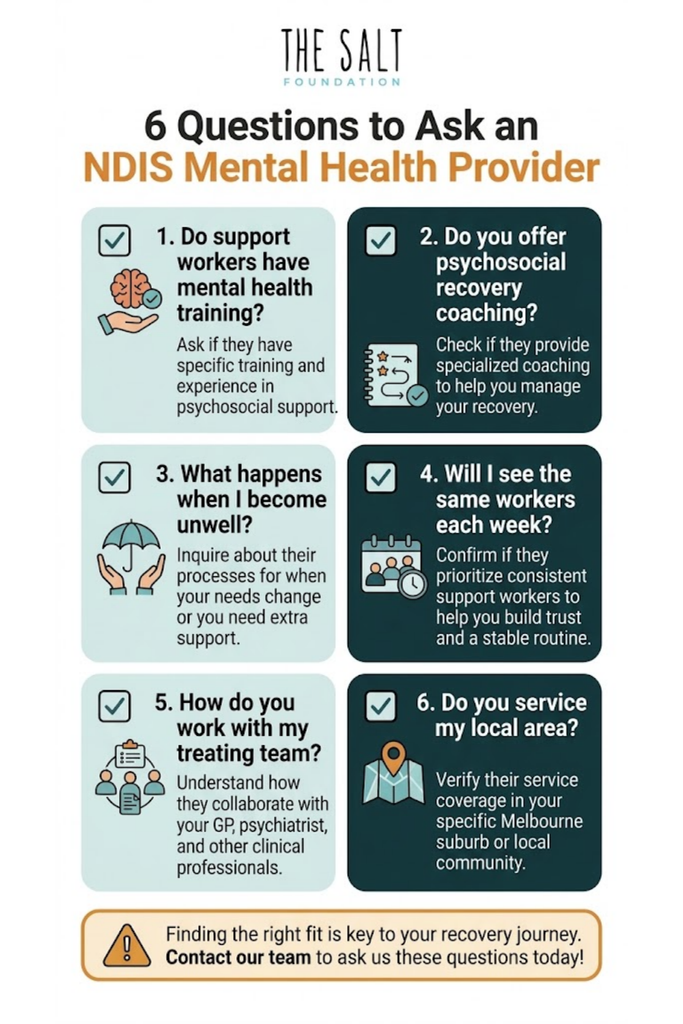
Consistency matters most to people with long-term mental illness. A worker who knows your routines notices early warning signs a stranger would miss.
SALT supports adults living with severe and enduring mental illness across Melbourne, Frankston and the Mornington Peninsula. We work from The Well in Heidelberg West and Asha House in Frankston.
That focus runs deep. SALT walked alongside adults living with long-term mental illness long before the NDIS arrived, says Roger Donnelley, SALT’s Chief Executive Officer. The work grew out of faith and “the belief that every person deserves to be known”.
Over the years, that experience became one of SALT’s real strengths. “We want families to know we see the person first,” Roger said. “A diagnosis is part of someone’s story, and our job is to get to know the rest of it.”
Action Steps
- Sort your needs into two lists: treatment, and help with daily life. Take the first to your GP and the second to the NDIS.
- Keep seeing your treating team. NDIS supports work alongside clinical care, never instead of it.
- If you plan to apply, book a dedicated appointment with your GP or psychiatrist to discuss NDIS evidence.
- Write down three examples of what a hard day stops you doing, and take them to that appointment.
- If you already have a plan, check your reassessment date and gather evidence of how your supports help you.
- Keep receipts, invoices and service agreements for at least three years.
- While you wait, contact a Mental Health and Wellbeing Local or Partners in Wellbeing.
- Ready to use your plan? Enquire with SALT, or ask a clinician or family member to make a referral.
Frequently Asked Questions
Yes, when a mental health condition causes a permanent, or likely permanent, psychosocial disability that substantially affects daily life. The NDIS funds disability supports, not clinical treatment.
The NDIS commonly funds daily living support, psychosocial recovery coaching, support coordination, help to join community activities, and therapy that builds skills and independence.
It can. Severe, ongoing anxiety can qualify as a psychosocial disability if it substantially reduces your capacity to manage daily tasks. A diagnosis alone is not enough, so your evidence must show the impact.
It can, when depression is severe, enduring and substantially limits daily life. Treatment for depression, including psychology under a mental health treatment plan, stays with the health system.
Obsessive-compulsive disorder can qualify when it causes lasting, substantial functional impairment. As with other conditions, the NDIS assesses impact rather than diagnosis.
Only if the sessions build your functional capacity and relate to your NDIS goals. You can’t use NDIS funding for clinical treatment, or for sessions already claimed under Medicare.
Generally no. The NDIS says emotional support animals and animals used in animal-assisted therapy are not assistance animals. It may fund an assistance animal trained by an accredited provider when the animal meets the funding criteria.
Rarely. The NDIS treats osteopathy for mental health as clinical treatment. It may instead fund an occupational therapist to work on the daily impact of your condition.
The NDIS describes a diagnosis as helpful if one is available. Your evidence must still show your mental health condition and how it affects everyday life.
Conclusion: Two Systems, One Life
The NDIS does cover mental health, but only one half of it. Your GP, psychiatrist and Medicare treat the illness. The NDIS supports the life around it: the shopping, the routines, the confidence to walk back into community. Know which system pays for what, gather evidence of your hardest days, and prepare early for the 2026 changes. Together We Thrive is this year’s Mental Health Month theme, and for people living with long-term mental illness, it starts with practical help that shows up every week.
Related Reading
- What Is Psychosocial Disability?
- What Is Disability? Unpacking the Definition in the NDIS Era
- Examples of Psychosocial Disability
- How to Diagnose Mental Health Issues
- How to Support Someone with Schizophrenia
- Where to Find Help with NDIS Application
- How to Get NDIS Funding

Daniel G. Taylor has been writing about the NDIS for six years. His focus has been on mental health and psychosocial disabilities as he lives with bipolar I disorder. He’s been a freelance writer for 32 years and lives across the road from a surf beach. He’s the author of How to Master Bipolar Disorder for Life and a contributor to Mastering Bipolar Disorder (Allen & Unwin) and he’s a mental health speaker. In May 2026, he celebrated 25 years without a major manic or depressive episode.