
Last Updated on 15/11/2026 by Daniel G. Taylor
Estimated reading time: 14 minutes
Your vote counts as much as anyone’s.
On Saturday 28 November, Victorians choose the next state parliament, and the people elected will shape the public transport you catch, the mental health services you rely on and the housing your family can find. Those decisions land hardest on people with disability. So your voice belongs in the count.
Voting with a disability can still feel like a puzzle. Where is the quiet venue? Who helps with the ballot paper? What happens if you can’t get out of the house? This guide answers those questions with the options the Victorian Electoral Commission (VEC) has built for this election, and it shows how a SALT support worker can help you get there.
The scale of this election matters too. The VEC expects almost 4.7 million Victorians to vote, across about 1,700 election day voting centres, 200 early voting centres and about 400 mobile voting services. Electoral Commissioner Sven Bluemmel calls the election ‘an opportunity for every eligible Victorian to have your say’. Every eligible Victorian includes you.
Key Takeaways
- Voting with a disability is important; your vote counts just like anyone else’s on 28 November.
- The Victorian Electoral Commission (VEC) offers various options and support for voting with a disability.
- Rights of voters include receiving help from support workers, family, or friends during the voting process.
- Prepare in advance by checking accessible venues and understanding your voting options, including low-sensory and early voting.
- Contact SALT for dedicated support to ensure you can participate in the election confidently.
Table of Contents
- Voting with a disability in Victoria: your rights come first
- Key dates for the 2026 Victorian state election
- How to vote if disabled: choose the option that suits you
- Accessible voting Victoria: help waiting at the voting centre
- Can you vote if you have a mental illness?
- Voting with intellectual disability: prepare with accessible information
- How SALT support workers help you vote
- Information for families, carers and support workers
- Research the candidates before you vote
- Action steps
- Frequently asked questions
- Conclusion: your voice belongs on the ballot paper
- Related reading
Voting with a disability in Victoria: your rights come first
The VEC states the principle plainly: everyone has the right to vote and the right to get support to vote. Victoria’s Charter of Human Rights and Responsibilities Act 2006 also protects your right to vote.
Voting is compulsory for every enrolled Victorian citizen aged 18 and over, and the VEC’s election FAQs for disability support staff confirm the rule includes people with disability. A disability doesn’t stop you voting. Instead, it opens the door to support.
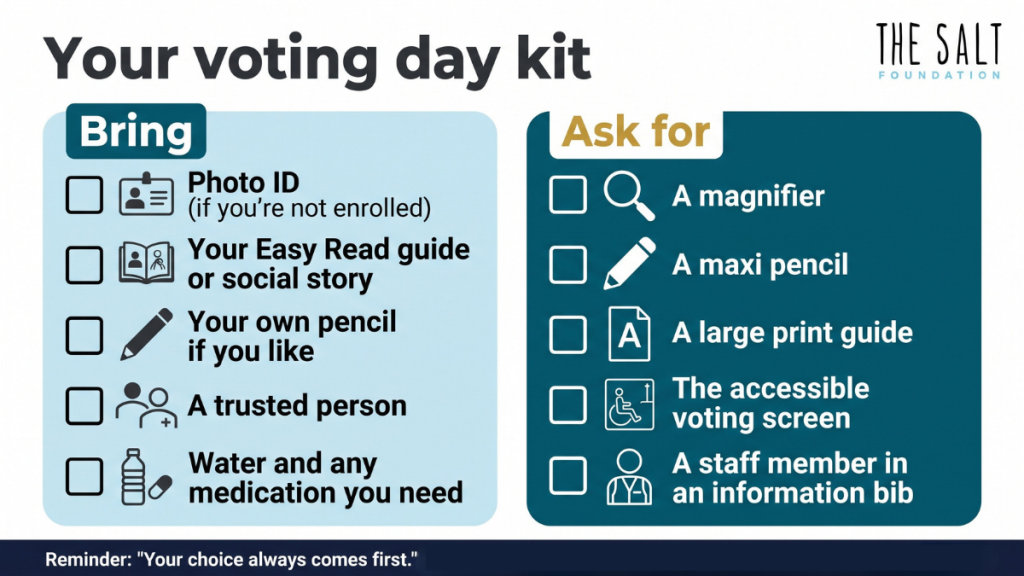
Your choice comes first, always. A carer, family member or support worker can explain, read, drive and steady your hand. However, the decision on the ballot paper stays yours.
For SALT, helping people vote is personal. ‘Many of the people we support have spent years feeling unheard by the systems around them,’ says Roger Donnelley, chief executive officer of The SALT Foundation. ‘Voting is one place where their voice counts exactly the same as everyone else’s.’
Donnelley is just as clear about where SALT’s role ends. ‘We don’t mind who people vote for. That choice is theirs alone,’ he says. ‘We want to make sure nothing stands between them and the ballot box. Helping people take part in community life is what SALT is here for, and that includes having a say in it.’
Did you miss the enrolment deadline? Enrolment closed at 8 pm on Tuesday 3 November, yet you can still enrol and vote on the spot at any early or election day voting centre. Tell a staff member you’re not enrolled, and bring a driver licence, an Australian passport, or a recent electricity bill or council rates notice showing your name and address.
Key dates for the 2026 Victorian state election
Mark these dates on the fridge, in your phone, or on the calendar your support worker checks each visit:
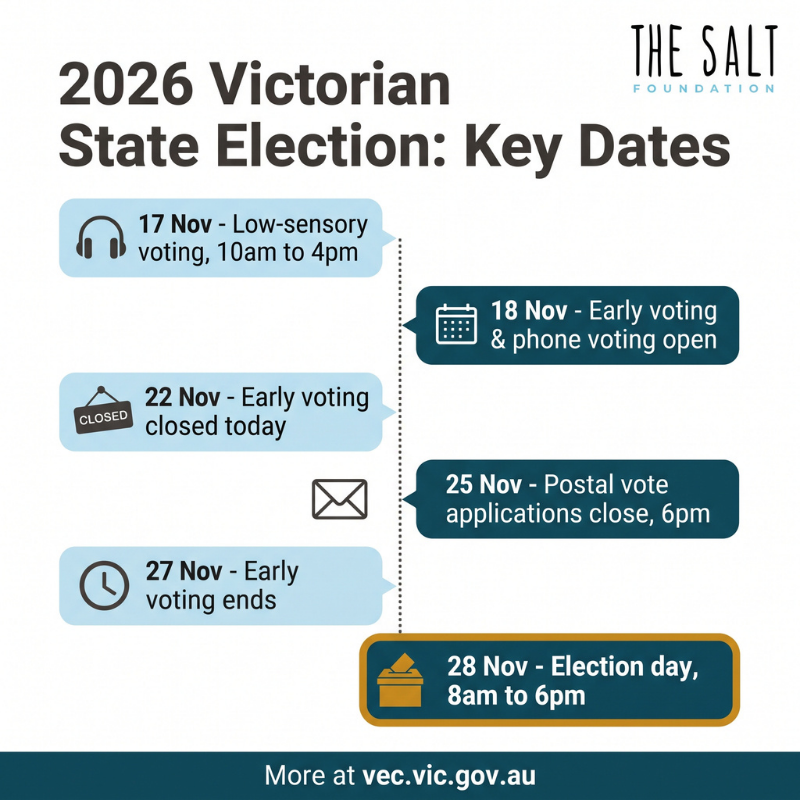
- Tuesday 17 November: low-sensory voting, 10 am to 4 pm, at one site in each district. Mobile voting also begins at some health care facilities.
- Wednesday 18 November: early voting and telephone-assisted voting open.
- Sunday 22 November: early voting centres close for the day.
- Wednesday 25 November, 6 pm: postal vote applications close.
- Friday 27 November: early voting ends.
- Saturday 28 November: election day, 8 am to 6 pm.
Two deadlines have already passed. Braille ballot registrations closed on Monday 2 November, and the electoral roll closed on Tuesday 3 November.
How to vote if disabled: choose the option that suits you
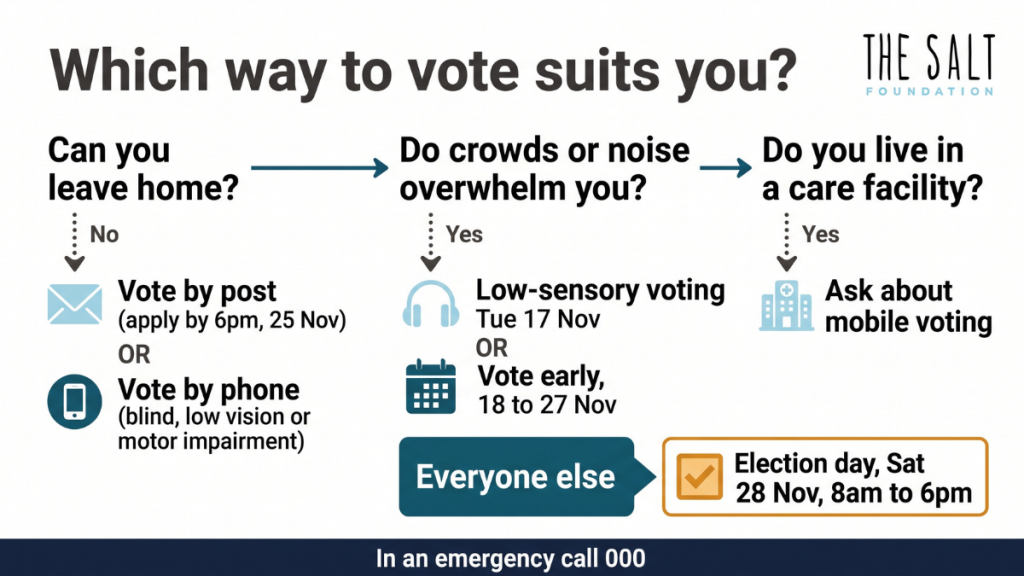
No single way to vote suits everyone. Some people want a quiet room; others want to vote from the kitchen table. The VEC offers 7 options, so pick the one that matches your body, your energy and your week.
Vote early, before the crowds
Early voting runs from Wednesday 18 to Friday 27 November, 9 am to 6 pm, every day except Sunday 22 November. You don’t need a reason. Shorter queues, calmer rooms and more time make early voting a smart choice for people who tire quickly or find crowds hard. Every early voting centre also has an assistive hearing device.
Try low-sensory voting
Low-sensory voting opens on Tuesday 17 November, from 10 am to 4 pm, a day before other early voting begins. Each district has one site. The VEC designed these sites for neurodivergent voters, people with sensory needs, and the carers and support workers beside them.
Expect more space around the voting booths, a quieter venue, lower or natural lighting, and staff trained to support people with non-visible disabilities. Find your nearest site through the VEC election venue locator.
Vote by post from home
Anyone can apply for a postal vote. Applications close at 6 pm on Wednesday 25 November, although the VEC advises you to apply early so your ballot pack arrives in time.
Once it arrives, post your completed vote or drop it at any Victorian voting centre by 6 pm on Saturday 28 November. The VEC must then receive it by Friday 4 December. If your mail is unreliable, ask for an emailed ballot pack instead. You’ll need a printer, though, and you can’t return the vote by email.
Vote by phone
Telephone-assisted voting suits voters who are blind, have low vision, or have a motor impairment and need help to cast a vote. It runs from Wednesday 18 to Saturday 28 November. Call 13 57 23 to register and vote between 9 am and 6 pm on early voting days, or between 8 am and 6 pm on election day.
Mobile voting
Mobile voting teams visit some health care facilities, aged care homes and homelessness support services from Tuesday 17 November. Ask your facility’s staff whether a team will visit and when.
Braille and large print
Braille registrations closed on Monday 2 November. If you registered, your braille ballot pack arrives by post, and you don’t need to do anything else. Every voting centre also stocks magnifiers and large-print guides.
Vote on election day
On Saturday 28 November, you can vote at any voting centre in Victoria between 8 am and 6 pm. Every early voting centre also becomes an election day voting centre, so a venue you checked in advance stays open on the day.
Accessible voting Victoria: help waiting at the voting centre
Walk into any Victorian voting centre and you can ask for help. Accessible voting in Victoria starts with people: staff wearing an information bib can guide you, and you can bring a carer, family member or friend to help you fill out your ballot paper.
The VEC also equips every voting centre with magnifiers, maxi pencils, large-print guides and an accessible voting screen. If you can’t write on the ballot paper, a trusted person or a VEC staff member can write for you. And you can still use your own pencil.
Before you go, check the venue’s access through the VEC election venue locator. Some centres offer independent wheelchair access, while others offer assisted access, and the difference matters if you plan to arrive alone.
‘A good voting day starts the visit before,’ says Catherine, a support worker at The SALT Foundation. ‘We check the venue, the opening hours and the access, and we pick a quiet time.’
On the day, Catherine handles the practical details. ‘I look after the parking and the queue, so the person I support can focus on the ballot,’ she says. ‘If they ask, I read it out or write their choices exactly as they say them. I never suggest who to vote for, and I don’t ask.’
Can you vote if you have a mental illness?
Yes. A mental illness doesn’t remove your right to vote, and neither does a diagnosis of schizophrenia, bipolar disorder, depression or anxiety. The VEC’s guidance for disability support staff says a person with disability can vote if they are enrolled and understand the nature of voting. Only a person who genuinely can’t understand the nature and significance of voting may not have to vote.
Still, election season can feel loud. ‘For someone living with psychosis or severe anxiety, the hardest part of voting is often everything around it,’ says Harriet Dixon, a psychosocial recovery coach at The SALT Foundation. ‘Crowds, people handing out flyers, a long queue.’
Dixon treats voting the way she treats any other step in recovery. ‘So we plan it like any other goal,’ she says. ‘We choose the option that feels manageable, whether that’s low-sensory voting, a quiet weekday morning or a postal vote at home. We read the Easy Read guide together and talk through what to expect.’
I live with bipolar I disorder, though I’m not an NDIS participant, and I find admin and ‘adulting’ tasks like voting challenging because of it. Before one election was announced, I booked tickets for a day trip. Then polling day fell on the same date. I didn’t know about early voting, so I thought an hour was plenty of time to vote. It wasn’t. When the hour was up, I’d barely moved in the queue.
I’d paid a couple of hundred dollars for the trip, and I wasn’t going to miss it. So I didn’t vote, and I got fined. Now I vote early, so I avoid the stress of election day.
If you live with a psychosocial disability, a psychosocial recovery coach can help you build a voting plan into your wider recovery goals. Our guide to what psychosocial disability is explains the barriers in more detail, and families can read how to support someone with schizophrenia day to day.
Voting with intellectual disability: prepare with accessible information
Preparation turns a strange day into a familiar one. For voting with intellectual disability, the VEC publishes a set of accessible resources through its community resources webpage:
- an Easy Read guide to voting at the 2026 state election
- a social story that walks through voting step by step
- short videos
- information in Auslan.
Read the Easy Read guide together a few days before, then practise filling in a sample ballot at the kitchen table. That way, the real ballot paper looks like something you’ve already done.
The VEC’s Democracy Ambassador Program also runs free voter education sessions covering enrolment and voting options. Group homes, day programs and families can book one.
How SALT support workers help you vote
A support worker can turn a plan to vote into a vote. At SALT, our support workers can help you:
- apply for a postal vote before 6 pm on Wednesday 25 November
- read the Easy Read guide or social story with you
- find your low-sensory or early voting venue and check its access
- drive you there and back
- stay beside you while you vote, or wait outside if you prefer.
Your NDIS plan may already fund this support. Help to get out into your community usually sits in your Core Supports budget, and your plan may include transport funding too. If you have a support coordinator, ask them to book the shift now, because early voting days fill fast.
‘More than half the people we support already have transport built into their support, so a trip to vote can often fit into an existing shift,’ says Greg Smith, chief operating officer at The SALT Foundation.
Ceejay, a SALT participant who lives with anxiety, schizophrenia and ADHD, put the value of that support simply in his real-life NDIS success story: ‘Without a support worker, I wouldn’t do that. I would stay home.’
Don’t have NDIS support? Victoria’s Multi Purpose Taxi Program gives eligible members with a severe and permanent disability a 50% discount on the fare, up to $60 per trip.
Ready to vote with support beside you? Call SALT on 1300 777 258 or send us an enquiry, and we’ll talk through how we can help, at this election and every day after it.
Information for families, carers and support workers
Carers, families, friends and supporters can help someone enrol, understand voting, prepare and access support. The VEC’s guide for families, carers and supporters explains your role, especially when the person you support has a cognitive impairment.
Disability organisations can also book free 30-minute training for their staff through the VEC. The VEC’s access and inclusion page gathers every guide, FAQ sheet and booking link in one place, so share it with your networks.
Support coordinators and families can make a referral to SALT if the person you support needs a regular support worker beyond election day.
Research the candidates before you vote
A confident vote starts with knowing what’s on offer. Before election day, find out who is standing in your district on the VEC’s 2026 state election page, then read their material or contact their offices. Questions worth asking include:
- How will you make public transport easier to use for people with disability?
- What will you do for community mental health services in our area?
- How will you increase accessible and affordable housing?
- How will you involve people with disability in decisions about disability services?
Your support worker can help you read candidate material or write an email. But they won’t tell you how to vote, because that decision belongs to you.
Action steps
- Decide how you’ll vote: low-sensory, early, postal, phone, mobile or on election day.
- If you choose a postal vote, apply before 6 pm on Wednesday 25 November.
- Find your venue on the VEC election venue locator and check its wheelchair access.
- Download the Easy Read guide or social story, and practise with a sample ballot.
- Book your support worker or transport now, before early voting days fill.
- If you’re not enrolled, take a driver licence, passport or recent bill to the voting centre.
- Bring someone you trust, and ask staff in information bibs for any help you need.
Frequently asked questions
Yes. Voting is compulsory for all enrolled Victorians aged 18 and over, including people with disability. If you can’t vote for a valid reason, such as illness, you can apply for an exemption. A person who genuinely can’t understand the nature and significance of voting may not have to vote.
Yes. Anyone can apply for a postal vote before 6 pm on Wednesday 25 November. If you’re blind, have low vision or have a motor impairment, you can also vote by phone from Wednesday 18 November by calling 13 57 23.
The VEC doesn’t list a home visit service for this election. Instead, mobile voting teams visit some health care facilities, aged care homes and homelessness services. If you live at home, a postal vote, a phone vote, or a support worker who drives you to a quiet venue offers the next best thing.
Apply online through the VEC’s postal voting page, or collect a paper form from an Australia Post office in Victoria. You don’t need to give a reason, and applications close at 6 pm on Wednesday 25 November.
Use the VEC election venue locator at maps.vec.vic.gov.au/elections. It lists every voting centre, and you can check whether a venue offers independent or assisted wheelchair access before you travel.
Your NDIS support worker can drive you if your plan funds community access or transport. Victoria’s Multi Purpose Taxi Program also halves taxi fares, up to $60 per trip, for eligible members. Some local councils run community transport too, so call yours to ask.
Yes, if you ask them to. A support worker can explain the process, read the ballot paper to you and write your choices for you. However, they must record your choices, not theirs.
Conclusion: your voice belongs on the ballot paper
This election, the VEC has built more ways to vote than ever: quiet rooms, phone lines, postal packs and mobile teams. Each one exists so that voting with a disability feels like any other Victorian’s vote, because it is.
Choose your option, mark the dates and book your support now. Then, on or before 28 November, cast a vote that carries your own experience into the next parliament. If you’d like a SALT support worker beside you, call 1300 777 258 today.
Related reading
- What Is Disability? Unpacking the Definition in the NDIS Era
- What Is Psychosocial Disability? Understanding the Barriers
- What Is a Support Worker in the NDIS?
- NDIS Travel Guidelines: Your Complete Guide to Accessing Travel Support
- How to Get NDIS Funding

Daniel G. Taylor has been writing about the NDIS for six years. His focus has been on mental health and psychosocial disabilities as he lives with bipolar I disorder. He’s been a freelance writer for 32 years and lives across the road from a surf beach. He’s the author of How to Master Bipolar Disorder for Life and a contributor to Mastering Bipolar Disorder (Allen & Unwin) and he’s a mental health speaker. In May 2026, he celebrated 25 years without a major manic or depressive episode.