

Last Updated on 12/10/2026 by Daniel G. Taylor
Estimated reading time: 17 minutes
Connection protects. Mental Health Month runs all through October, and Mental Health Australia’s 2026 theme, Together We Thrive, carries a simple message: people do better when they stay close to others. So this guide shows you how to support someone with schizophrenia, and how to keep yourself well too.
The need runs deep. Mental Health Australia’s research, released on 1 October, found 64% of people believe we are becoming more disconnected from each other. For families who care for an adult with a severe, long-term illness, that drift feels personal. Friends fall away. Services change names. And the person you love sometimes hides behind symptoms nobody else can see.
Families do not carry this alone. Support workers often see the person more often than anyone outside the home. They share the kitchen, the bus trip and the hard afternoon. So when this guide says “carer”, read it broadly: it speaks to the parent, the partner, the sibling and the paid support worker who shows up each week.
World Mental Health Day passed on 10 October. The work did not. Across Melbourne and the Mornington Peninsula, SALT supports adults who have lived with these conditions for years, often decades. We also work beside the families who never stopped showing up, and we train and back the support workers who show up with them.
This post belongs to SALT’s Mental Health Month series. Read it with our guides to how mental health conditions get diagnosed, what the NDIS covers for mental health and what psychosocial disability looks like in everyday life.
Key Takeaways
- Mental Health Month highlights the importance of connection, especially for those supporting individuals with schizophrenia.
- Understanding schizophrenia, its symptoms, and effective communication strategies is crucial for caregivers and support workers.
- Practical strategies for supporting someone with schizophrenia include maintaining routine, recognising negative symptoms, and encouraging medication adherence.
- Crisis planning is essential; identify warning signs early and develop a plan before a crisis occurs.
- Carers and support workers must prioritise their own well-being to effectively assist those with schizophrenia.
Table of Contents
- Understanding Schizophrenia, Schizoaffective Disorder and Psychosis
- How to Talk with Someone Experiencing Psychosis or Paranoia
- Negative Symptoms: When It Looks Like Laziness but Isn’t
- How to Support Someone with Schizophrenia at Home
- Warning Signs and Crisis Planning
- Looking After Yourself as a Carer
- Looking After Yourself as a Support Worker
- Where the NDIS Fits
- Action Steps
- Frequently Asked Questions
- Conclusion: Thriving Together, One Steady Week at a Time
- Related Reading
Understanding Schizophrenia, Schizoaffective Disorder and Psychosis
Psychosis is a symptom, not a diagnosis. Healthdirect describes psychosis as a condition where a person loses touch with reality. It can also show up in bipolar disorder, major depression and other conditions. So one episode never tells the whole story.
Schizophrenia is a long-term illness. It affects how a person thinks, feels, acts and sees what is real, and it usually starts in the late teens or early twenties. SANE says it affects around 2.4 people in every 1,000 Australians.
Schizoaffective disorder sits on the same spectrum. It mixes symptoms of psychosis with bouts of depression or mania. As a result, mood and reality can both shift at once.
Positive and Negative Symptoms
Doctors sort the symptoms into groups. Positive symptoms add something: false beliefs, voices or visions, and muddled thinking. Negative symptoms take something away, such as drive, pleasure, feeling and speech. Healthdirect also lists thinking symptoms, such as trouble with focus and memory. Here, “positive” does not mean good. It means present.
A Word on Language
You may still hear the phrase “paranoid schizophrenia”. However, the American Psychiatric Association removed it from the official diagnoses when it published the DSM-5 in 2013. Paranoia is still a common symptom. But it no longer names a separate condition.
Words matter at home and on shift. Your son lives with schizophrenia; he is not “a schizophrenic”. The same goes for the participant you support: put the person first, and the illness second.
How to Talk with Someone Experiencing Psychosis or Paranoia
Your instinct will tell you to correct. Resist it. SANE advises families not to dismiss or argue with hallucinations and delusions, and not to pretend to agree with them either. Argument hardens a belief. Agreement feeds it. Calm, honest listening, by contrast, makes room for trust. That is the heart of how to support someone with schizophrenia when their world feels unsafe.
Learning how to interact with someone with schizophrenia during paranoia takes practice. Nobody gets it right every time, whether they are a parent at the dinner table or a support worker on a morning visit. Still, these habits help:
- Listen to the feeling, not the content. “That sounds frightening” validates fear without confirming the threat.
- Keep sentences short and simple. Psychosis makes talk hard to follow, so offer one idea at a time.
- Lower the heat. Speak slowly, sit rather than stand over the person, and give them time to answer.
- Stay honest. If you hear no voices, say so gently: “I can’t hear it, but I can see it’s upsetting you.”
- Choose your moment. Talk about treatment when symptoms ease, not at the peak of distress.
What a Support Worker Does First

Catherine, a SALT support worker, meets these moments often. Her first move is to slow everything down. She lowers her voice, sits rather than stands, and gives the person room. “I don’t argue with what they are seeing or hearing,” she says. Instead, she names the fear and promises to stay: “That sounds really frightening. I’m here, and I’m not going anywhere.”
Then she offers something ordinary, such as a cup of tea or a short walk outside. Catherine believes families can borrow the same approach. “Name the feeling, stay calm, and offer one small, ordinary thing,” she said.
Negative Symptoms: When It Looks Like Laziness but Isn’t
Negative symptoms often cause more family fights than voices do. A son who sleeps until two in the afternoon, skips showers and leaves dishes for days looks unmotivated. SANE is clear on this point: pulling away, trouble getting out of bed and a lack of drive are symptoms of a mental health condition, not laziness.
Support workers meet the same frustration from another angle. A shift planned around a shopping trip can stall at the front door. A participant who agreed to a walk on Monday may refuse it on Tuesday. Neither carer nor worker has failed. The illness has simply shown up for the day.
Match each symptom to a task. Low drive stalls the grocery shop. Lost pleasure empties the weekend. Withdrawal cancels the family dinner, and a poor memory loses the appointment card. Once you name the barrier, you can plan around it instead of fighting it.
Practical help beats pep talks. Break tasks into small steps. Pair a hard job with a fun one. Then praise effort as much as results, and measure progress in weeks, not days.
How to Support Someone with Schizophrenia at Home
Living with schizophrenia means living with an unpredictable illness. So a predictable week becomes a kind of medicine. Regular sleep, meals and activity give symptoms less room to move. A shared calendar for appointments, injections and blood tests also helps. It works best when you offer a lift or company, not just a reminder.
Small anchors work better than big plans. Harriet Dixon, a Psychosocial Recovery Coach at SALT, knows a full routine can feel impossible after years of disruption. So she starts with one fixed point in the day, such as getting up by ten or walking to the shop each morning for milk. “The first goal should feel almost too easy,” she says. Once it holds for a few weeks, she adds the next one.
Harriet’s advice applies to families and support workers alike. Notice the effort and encourage it, but resist the urge to step in and do the task yourself. “The goal belongs to the person,” she said, “and so does the win.”
I live with bipolar I disorder, not schizophrenia, but I know what psychosis does to words. When I was in a depressed phase or during a psychosis, I couldn’t articulate what help I needed. That’s why it’s key for families and carers to learn how they can support their loved one with schizophrenia, and to discuss what that person needs while they are “well”.
Physical Health Counts
Physical health matters just as much. People treated for schizophrenia are much more likely to be overweight, have high blood pressure and get diabetes. Side effects of medicine play a part. Regular GP check-ups catch these problems early. So encourage them, and offer to come along. A support worker who knows the person well can also help them get to the appointment and remember what the doctor said.
Medication: Encourage, Don’t Manage
Your role is to encourage, not to manage. SANE suggests pharmacy dose packs and calendars to make tablets easier to remember. If side effects bother your family member, urge them to tell their psychiatrist rather than stop alone. After all, stopping too soon can bring symptoms back. Support workers should follow their provider’s medication policy and the participant’s support plan, and report any missed doses or worrying side effects to their team leader.
Apps, Reminders and Their Limits
Apps help some people. Phone alarms, calendar alerts and medication reminder apps suit anyone who uses a phone every day. Still, treat them as prompts, not treatment. Check privacy settings before anyone enters health details. And remember: no app notices a relapse the way a familiar face does. For help finding digital and local services, call Medicare Mental Health on 1800 595 212.
Coping with Voices
Many people learn to live alongside voices. A form of talk therapy called CBT for psychosis helps people change how they react to voices, and SANE notes some evidence a brain stimulation treatment called rTMS can quieten them. Peer support also helps, because people who hear voices often trust others who have been there.
Everyday help matters as much as therapy. When you support someone with schizophrenia through the NDIS, SALT’s Core Supports team helps NDIS participants with shopping, cooking, cleaning, appointments and getting out into the community.
Warning Signs and Crisis Planning
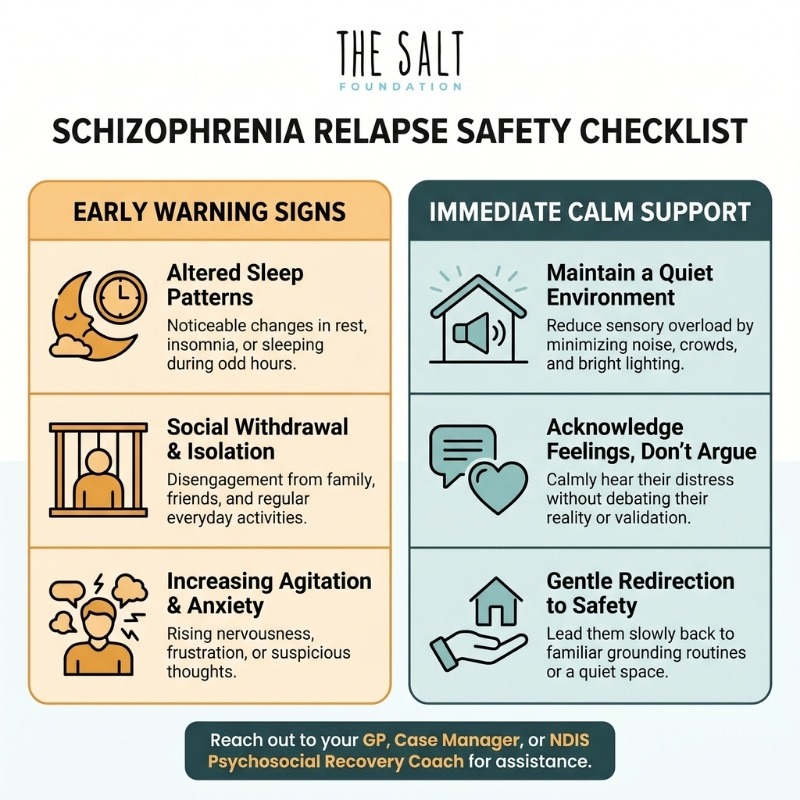
Relapse rarely arrives without warning. SANE lists early signs such as poor sleep, suspicion, pulling away, trouble keeping track of talk, and poor hygiene. You know your family member’s signs better than any doctor does. Support workers see them too, often first, because they visit on a regular rhythm. So write them down, and agree on who tells whom when the signs appear.
Make the Plan While Things Are Calm
Draft the crisis plan in calm weather. A relapse prevention plan names triggers, warning signs, responses and support people. SANE suggests family members and a trusted health worker each keep a copy. Then add the treating team’s contacts, a current list of medicines and the person’s own wishes about care. With the person’s consent, share it with the support team, so everyone reads from the same page.
De-escalation Basics
Most people with psychosis do not act aggressively. Even so, every carer and support worker needs a plan for the rare moment when distress spills over. SANE’s advice is practical: keep a safe distance, speak in a level voice and short sentences, avoid sudden moves, and never threaten anyone with police. Above all, never put yourself at risk. Support workers should leave if they feel unsafe, follow their provider’s incident procedures, and report what happened to their team leader the same day.
Training also builds confidence. Mental Health First Aid Australia runs a 12-hour Standard course, delivered across Victoria, covering psychosis and severe psychotic states.
Urgent Care That Keeps People Out of Hospital
Not every crisis needs an emergency department. Unless someone is in immediate danger, call your local mental health triage line first. Triage clinicians assess the situation over the phone and match the response to the need.
Two Victorian services can keep a person out of an inpatient ward. First, the Acute Community Intervention Service (ACIS) can come to the person’s home and assess them there. Second, Prevention and Recovery Care (PARC) units offer short-term residential care in a home-like setting, with clinical staff on hand.
A “step-up” PARC stay suits someone who is becoming unwell but does not yet need a hospital bed. Stays usually last between 7 and 28 days. Referrals come through the area mental health service, so ask triage about PARC early, while the warning signs are still small.
Who to Call in Victoria
Keep these numbers on the fridge and in your phone:
- Immediate danger: call triple zero (000).
- Frankston and the Mornington Peninsula: Bayside Health Peninsula Mental Health Telephone Triage on 1300 792 977, 24 hours a day.
- Elsewhere in Melbourne and Victoria: every public mental health service in Victoria runs a 24-hour triage line, searchable by suburb.
- Advice and referrals: NURSE-ON-CALL on 1300 60 60 24.
- Crisis support: Lifeline on 13 11 14, or SuicideLine Victoria on 1300 651 251.
Looking After Yourself as a Carer
Carers burn out quietly. Sleep goes first, then friends, then health. Your wellbeing matters for its own sake. It also keeps the caring going. Because you cannot pour from an empty cup, these services exist for you:
- Tandem, Victoria’s peak body for mental health carers, runs a free support line on 1800 314 325, weekdays from 9 am to 5 pm. It can also help with the NDIS.
- Carer Gateway on 1800 422 737 connects carers with counselling, coaching and peer support.
- SANE offers free digital and telehealth support on 1800 187 263, plus a 24/7 Friends, Family and Carers online forum.
- Mental Health and Wellbeing Connect centres welcome anyone who cares for a person with mental ill health. You need no referral.
- Mind Australia’s carer helpline, on 1300 554 660, offers counselling, peer support and support groups.
Low-cost therapy is closer than many families think. First, a GP can help. They can prepare a Mental Health Treatment Plan for sessions with a Medicare rebate. Mental Health and Wellbeing Locals offer free support to adults aged 26 and over, with no GP referral or Medicare card needed.
Money stress makes everything harder. If caring limits your work, read our guide to the Carer Payment and Carer Allowance. Your family member may also qualify for the Disability Support Pension through Services Australia.
Ask for Help Sooner
Greg Smith, SALT’s Chief Operating Officer, says families rarely surprise the team. “Around 30% of SALT participants live with schizophrenia or a related psychotic disorder,” he said. It is the largest single diagnosis group SALT supports. So in that first conversation, Greg wants families to know they can be honest about how hard things have become.
His regret runs the other way. “What I wish more families asked for sooner is support for themselves,” Greg says. Too many wait until they are exhausted. Asking early about carer support and a crisis plan, he believes, makes everything that follows easier.
Looking After Yourself as a Support Worker
Support workers carry weight too. You walk into someone’s home, absorb their fear for a few hours, then catch the train home with it still in your chest. Over months, that load adds up. The person you support deserves a worker who is well. So do you.
Watch for changes in yourself. Common signs of strain include:
- Dread before a shift, or relief when one gets cancelled.
- Poor sleep, or replaying a hard visit long after you leave.
- Irritability with the people you support, or with your own family.
- Feeling numb, flat or detached on shift.
- Pulling away from the friends and activities that used to restore you.
None of these signs means you are bad at the job. They mean the job is hard, and you need support to keep doing it well.
Boundaries help. Finish your shift notes, then let the shift end. Debrief a hard visit with your team leader rather than carrying it alone. Keep the habits that steady you, such as sleep, movement, meals and time with people who make you laugh.
Why Working with a Provider Makes a Difference
Independent support workers often carry these moments on their own. Nobody checks in after a frightening visit. Training comes out of their own pocket and their own time. And when a participant’s warning signs appear, they may not know who to call.
Working with an organisation like SALT changes that picture. Our support workers sit inside a team, with team leaders, Psychosocial Recovery Coaches and support coordinators close by. SALT offers additional training and support for workers who support people with schizophrenia and other mental health conditions. Our guide to becoming an NDIS support worker explains why joining a provider often makes sense.
If you work with SALT and feel worried, or you notice changes in yourself while you support someone with schizophrenia or any mental health condition, come and talk to us. Speak with your team leader early, well before the strain turns into burnout. Asking for help is part of the job, not a sign you cannot do it.
Every support worker can also use the free services listed above. Lifeline (13 11 14) and the Beyond Blue Support Service (1300 22 4636) answer around the clock, and Mental Health and Wellbeing Locals welcome adults without a referral.
Where the NDIS Fits
The NDIS funds disability supports, not clinical treatment. So your family member’s psychiatrist and treating team still manage diagnosis and medicine. But when schizophrenia makes daily tasks hard for the long term, it may count as a psychosocial disability, and the NDIS can fund practical help.
That help might include daily living support at home and in the community, or Psychosocial Recovery Coaching to build skills and routines. Our updated NDIS mental health guide, part of this series, answers the detailed eligibility and schizophrenia questions.
For Roger Donnelley, SALT’s Chief Executive Officer, the approach starts with faith. Seeing the person before the diagnosis, he says, grows out of “the belief that every person carries dignity and worth, whatever their illness”. In practice, SALT sees your son, daughter or partner first, not their symptoms or their file. “We walk alongside the whole family for the long haul,” Roger said.
Action Steps
- Learn the basics together. Read the SANE and Healthdirect schizophrenia pages. Then talk with your family member about what fits their experience.
- Practise one new communication habit this week, such as reflecting feelings instead of debating beliefs.
- Write a relapse prevention plan while things are calm, and share copies with the treating team and, with consent, the support team.
- Save the crisis numbers above in your phone and on paper.
- Book something for yourself. Call Tandem or Carer Gateway, or join a carer support group.
- Support workers: notice your own warning signs, and talk to your team leader before strain becomes burnout.
- Explore NDIS supports. Enquire with SALT, or ask a health professional to make a referral.
Frequently Asked Questions
Start with the relationship, not the diagnosis. Many people with psychosis cannot see their own symptoms, so arguing about the illness rarely works. Instead, focus on what they want, such as better sleep or less conflict. Then link help to those goals. You cannot force help in most situations, but you can speak with a GP or the local triage service yourself.
For most families, yes. SANE’s schizophrenia factsheet notes people living with schizophrenia are more likely to be survivors of violence than perpetrators, and around 96% of violence in the community comes from people without complex mental health issues. Still, take any threat seriously and call 000 if anyone is in danger.
Many can. Healthdirect says many people with schizophrenia live meaningful lives with treatment. Even so, recovery looks different for each person. For some it means work and love; for others, a stable home and a good week.
Stay calm, listen without arguing, and keep things simple. Then ask whether they would like help to contact their doctor. If they seem at risk, call the local triage line or 000.
Watch for changes in your sleep, mood and energy, and debrief hard visits instead of carrying them home. Keep clear boundaries around your shifts. If you work with a provider like SALT, talk to your team leader early and ask about the training and support on offer.
Set clear, kind house rules about noise, money and shared jobs, and agree on them while things are calm. Also make sure you have your own support, because one person’s illness affects the whole household.
Start with a GP, who can refer to a psychiatrist or a public mental health service. You can also search for psychiatrists by area and interest through the psychiatry college’s Your Health in Mind directory.
Try Mental Health and Wellbeing Locals, SANE’s free digital support, Tandem’s support group database and Carer Gateway. Australian mental health charities, including SANE, Mind Australia and Wellways, also publish free resources for families.
Conclusion: Thriving Together, One Steady Week at a Time
Knowing how to help someone with schizophrenia does not take clinical training. It takes patience, a plan and people around you. So listen to the feeling, name the barrier, write the plan, and look after yourself along the way. That holds for the parent at home and the support worker on shift. Together We Thrive is more than a slogan this October. For families and the workers beside them, it describes the work.
Related Reading
- What psychosocial disability means under the NDIS
- Whether the NDIS covers mental health conditions
- Real examples of psychosocial disability in daily life
- How professionals diagnose mental health conditions
- Carers Payment 2026 Guide for Melbourne Families
- Becoming a Carer for a Family Member
- The Role of Disability Support Workers: Key Character Traits

Daniel G. Taylor has been writing about the NDIS for six years. His focus has been on mental health and psychosocial disabilities as he lives with bipolar I disorder. He’s been a freelance writer for 32 years and lives across the road from a surf beach. He’s the author of How to Master Bipolar Disorder for Life and a contributor to Mastering Bipolar Disorder (Allen & Unwin) and he’s a mental health speaker. In May 2026, he celebrated 25 years without a major manic or depressive episode.